Older cars may lack the convenience of a factory head-up display, but an aftermarket HUD can add essential driving information without replacing the dashboard or installing a complicated infotainment system.
This roundup compares 10 car head-up displays for older cars, including OBD2 models that read vehicle data and GPS units that work independently. Look for the connection type, display readability, supported measurements, and installation requirements that best match your vehicle.
Best 10 Car Head Up Displays for Older Cars Picks for 2026
OBD2 + GPS Choice
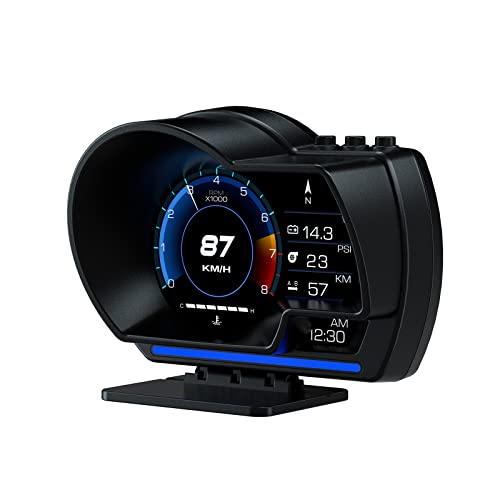
- OBD2 and GPS modes
- Displays speed and vehicle data
- Dashboard or windshield mounting
Best For: Older-car drivers wanting detailed readouts and flexible compatibility
Simple USB Pick

- USB-powered installation
- GPS/BDS speed positioning
- Overspeed alerts and auto brightness
Best For: Older cars with USB power and no need for OBD2 data
Dual-Projection Option

- Direct OBD2 setup
- Front and floating projection modes
- Speed and temperature display
Best For: Compatible older OBD2 vehicles needing flexible viewing modes
Large-Screen GPS Pick

- GPS-based compatibility
- Large multi-data display
- Overspeed and fatigue alerts
Best For: Older cars without OBD2 needing a large, feature-rich screen
Best OBD-II Fit

- 5.5-inch color display with reflection reduction
- Shows speed, temperature, voltage, fuel use, and mileage
- Supports compatible OBD-II and EUOBD vehicles
Best For: Compatible older cars needing a large, data-rich OBD-II display
Best Data-Rich Option
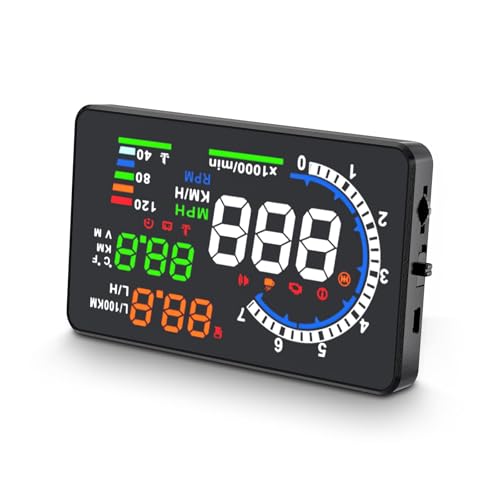
- Large 5.5-inch HD screen
- Displays driving data and multiple alerts
- Adds vehicle fault detection and clearing functions
Best For: Compatible OBDII or EOBD vehicles needing extra data and diagnostics
Best Simple Setup
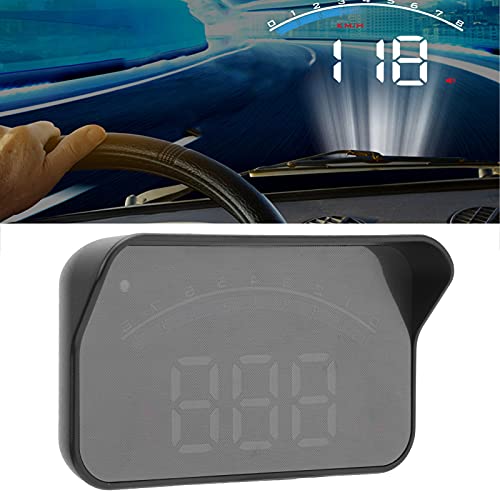
- Plug-and-play OBD connection
- Displays speed, RPM, temperature, voltage, and faults
- Includes brightness controls and multiple alerts
Best For: Compatible OBDII drivers wanting a compact, easy-to-connect HUD
Best GPS Plug-and-Play Pick

- GPS+BDS positioning with a 10Hz refresh rate
- USB-powered installation with MPH/KMH switching
- Large display, brightness control, and overspeed alert
Best For: Older drivers seeking a simple, readable GPS speed display
Best Multifunction Upgrade

- Large 5.5-inch display with automatic brightness
- Shows speed, RPM, temperature, voltage, and fuel use
- Adds OBD2 diagnostics and vehicle alerts
Best For: OBD2-equipped cars needing a larger, information-rich display
Best Compact USB Option

- USB-powered and does not require an OBD port
- GPS+BDS tracking with a 10Hz refresh rate
- Large font and automatic brightness adjustment
Best For: Drivers wanting a compact GPS speed display for older vehicles
OBD2 + GPS Choice – P6 Smart Gauge HUD
For drivers comparing car head up displays for older cars, the wiiyii P6 is a flexible option when the vehicle supports OBD2. It combines OBD2 data with GPS and can display speed, voltage, fuel consumption, RPM, and water temperature without permanent installation.
Best For: Drivers who want detailed vehicle information, adjustable mounting, and GPS fallback for cars without a compatible OBD2 protocol.
Pros:
- Dual OBD2 and GPS modes provide broader compatibility.
- Displays more than basic speed, including RPM, voltage, fuel consumption, and water temperature.
- Includes dashboard and windshield mounting options with an adjustable bracket.
- Automatic brightness adjustment and a red overspeed warning help visibility.
Cons:
- OBD2 features depend on the vehicle’s supported protocol.
- The unit is more feature-focused than minimalist GPS-only displays.
The P6 stands out for older-car owners who want diagnostic-style information as well as a speed readout. Its dual-mode design is useful, but buyers should confirm which OBD2 data their vehicle can provide.
Simple USB Pick – Universal Plug-and-Play HUD
This USB-powered model is a straightforward choice among car head up displays for older cars, provided the vehicle has a USB interface. It uses GPS/BDS positioning, projects speed onto the windshield, and starts automatically when powered.
Best For: Drivers seeking an easy-install speed display with no OBD2 wiring, adjustable overspeed alerts, and automatic brightness control.
Pros:
- Plugs into a vehicle USB port without technical installation.
- GPS/BDS positioning and a 10Hz refresh rate support responsive speed readings.
- Offers MPH/KMH switching and three adjustable overspeed alerts.
- Built-in sunshield and automatic brightness adjustment help with daytime and nighttime viewing.
Cons:
- Requires a USB-equipped vehicle and does not provide OBD2 vehicle data.
- Its primary readout is speed rather than a broad gauge set.
For an older vehicle with USB power but no convenient OBD2 access, this HUD keeps setup simple. It is best suited to buyers who prioritize speed visibility and alerts over engine-monitoring information.
Dual-Projection Option – OBD2 Floating HUD
The dual-screen OBD2 model offers a practical upgrade for car head up displays for older cars made after the stated compatibility dates. It connects directly to the OBD2 port and can show speed and temperature through both its front display and floating windshield projection.
Best For: Owners of compatible OBD2 vehicles who want speed and temperature visibility plus switchable display modes.
Pros:
- Direct OBD2 connection avoids complex wiring or tools.
- Dual-screen mode lets drivers switch between the front display and floating projection.
- Shows speed and temperature while also supporting turbo pressure and fuel statistics in the alternate mode.
- ABS and PC construction is designed for everyday driving conditions.
Cons:
- Compatibility is limited to most OBD2 vehicles made after 2004 in the U.S. or 2008 globally.
- OBD2 access is required, so it is not a universal fit for every older car.
This is a good match for buyers who want more than a single projected speed number. Its strongest advantage is the combination of OBD2 setup and dual viewing modes, assuming the vehicle meets the stated compatibility range.
Large-Screen GPS Pick – SinoTrack 5.5-Inch HUD
The SinoTrack is a strong GPS-based choice among car head up displays for older cars because it does not rely on OBD2 data. Its large 5.5-inch screen displays speed, driving time, mileage, time, direction, and satellite information, making it useful for vehicles with limited onboard connectivity.
Best For: Drivers who want a large, information-rich GPS display with overspeed and fatigue-driving reminders.
Pros:
- GPS operation suits vehicles that cannot provide OBD2 data.
- Large 5.5-inch screen displays speed and multiple trip details simultaneously.
- Automatic brightness adjustment supports viewing in changing light conditions.
- Includes overspeed and fatigue-driving alerts.
Cons:
- It shows current trip mileage but does not retain or accumulate total distance after power is off.
- Must use the specified 5V power supply; higher voltage is prohibited.
- The large display may appeal less to buyers seeking a very compact unit.
The SinoTrack is particularly practical for older cars without dependable OBD2 compatibility. Its generous screen and safety reminders add convenience, though buyers should plan carefully for the unit’s power requirements and trip-mileage limitation.
Best OBD-II Fit – 5.5-Inch Multifunction HUD
For drivers comparing car head up displays for older cars, this 5.5-inch model is a practical OBD-II option when your vehicle meets the listed production-year requirements. It projects speed and other vehicle information while offering automatic or manual brightness adjustment for changing light conditions.
Best For: Drivers with compatible OBD-II or EUOBD vehicles who want a large display with speed, temperature, voltage, fuel-consumption, and mileage information.
Pros:
- Compatible with OBD-II or EUOBD vehicles, including U.S. vehicles produced after 2004 and vehicles from other countries after 2008.
- Large 5.5-inch color screen uses nanometer technology to help reduce reflection.
- Displays speed, water temperature, battery voltage, fuel consumption, and mileage.
- Supports automatic power-on and power-off with the vehicle and operates across a broad temperature range.
Cons:
- Compatibility depends on the vehicle having the supported OBD-II or EUOBD interface.
- The manufacturer recommends professional installation.
- Some setup functions require using the device buttons.
Its broad data display and large screen make it a versatile choice for compatible older cars. Verify the vehicle interface and model year before ordering, then follow the included instructions or use professional installation.
Best Data-Rich Option – wiiyii A8 5.5-Inch HUD
The wiiyii A8 is worth considering among car head up displays for older cars when you want more than a basic speed readout. Its 5.5-inch HD screen displays driving data and adds vehicle fault detection, alarms, and fault-clearing functions, provided your car uses the supported OBDII or EOBD system.
Best For: Drivers with compatible OBDII or EOBD vehicles who want broad trip information and additional diagnostic-oriented functions.
Pros:
- Large 5.5-inch HD display with an 800×480 native resolution.
- Displays speed, water temperature, voltage, driving distance, and fuel consumption.
- Includes speeding and voltage alarms plus kilometer/mile switching.
- Can read vehicle data for failure detection, failure alarms, and failure clearing.
Cons:
- Does not support OBD I or JOBD vehicles.
- Compatibility is limited to vehicles using the listed OBDII or EOBD systems.
- The supplied notes do not establish compatibility with every older vehicle.
The A8 stands out for combining a large windshield-facing display with extra vehicle-information features. Check whether your car uses the required OBDII or EOBD connection before relying on its compatibility claims.
Best Simple Setup – M6S 3.5-Inch OBD HUD
For shoppers seeking car head up displays for older cars, the M6S offers a straightforward plug-and-play approach through the vehicle’s OBD interface. It projects key information such as speed, RPM, temperature, and voltage, while also providing brightness controls and several driving alerts.
Best For: Drivers with compatible OBDII vehicles who prefer a compact HUD with automatic data reading and safety-oriented reminders.
Pros:
- Connects to the OBD interface and starts displaying data when the engine starts.
- Shows speed, engine RPM, water temperature, voltage, and fault information.
- Offers speed, voltage, water-temperature, fatigue-driving, and fault alerts.
- Supports automatic and manual brightness adjustment for different conditions.
Cons:
- Compatibility is limited to OBDII-compliant vehicles.
- The notes specify that OBDII applies to vehicles produced after 2008.
- It is not compatible with the listed hybrid, diesel, pickup, sedan, or computer-modified vehicles.
The M6S keeps installation simple and focuses on essential driving information and alerts. Its compatibility exclusions are significant, so confirm your vehicle type and OBDII support carefully before purchasing.
Best GPS Plug-and-Play Pick – K4 Car HUD
For drivers comparing car head up displays for older cars, the K4 offers a straightforward USB-powered setup without requiring an OBD2 connection. Its GPS+BDS positioning, large speed display, adjustable brightness, and overspeed alert focus on the information most drivers need.
Best For: Older drivers who want a simple, readable GPS speed display with flexible installation.
Pros:
- Uses GPS+BDS signals and a 10Hz refresh rate for responsive speed tracking.
- USB plug-and-play power avoids complex installation.
- Large, anti-reflective display with adjustable brightness supports day and night viewing.
- Offers MPH/KMH switching, speed calibration, and a customizable overspeed alert.
Cons:
- GPS performance may be affected in tunnels, garages, severe weather, or behind metallic windshield film.
- Requires a USB power source in the vehicle.
The K4 is a practical choice when you want essential speed information rather than extensive vehicle diagnostics. Its calibration option is useful if the GPS reading needs to be matched more closely to the vehicle dashboard.
Best Multifunction Upgrade – A8 5.5-Inch OBD2 HUD
The A8 is a more feature-heavy option among car head up displays for older cars. Its 5.5-inch screen can show speed alongside RPM, water temperature, voltage, and fuel consumption, while its OBD2 connection adds diagnostic and vehicle-alert functions.
Best For: Drivers with an OBD2/EOBD-equipped vehicle who want a large display and broader vehicle information.
Pros:
- Large 5.5-inch HD display with automatic brightness adjustment.
- Shows GPS speed, RPM, water temperature, voltage, and fuel consumption.
- Provides overspeed and voltage alerts.
- OBD2 functions include failure detection, alarms, and failure-code clearing.
Cons:
- Compatibility is intended for vehicles with OBD2/EOBD protocols, widely used after 2003.
- OBD2 installation may be less suitable for vehicles without a compatible port.
This model makes the most sense if your older car supports OBD2 and you want more than a basic speedometer. Its larger screen and vehicle-status data provide a broader dashboard-style view, but compatibility should be checked before purchase.
Best Compact USB Option – K1 GPS Car HUD
For a compact choice in car head up displays for older cars, the K1 uses USB power and GPS rather than relying on an OBD port. It displays speed in a large font, automatically adjusts brightness, and is designed for cars, trucks, and motorcycles with a USB connection.
Best For: Drivers wanting a compact, no-OBD speed display that works across multiple vehicle types.
Pros:
- USB-powered design works without an OBD port.
- GPS+BDS positioning supports up to 32 satellites and a 10Hz refresh rate.
- Automatic brightness adjustment helps adapt to daytime and nighttime conditions.
- Large, anti-reflective speed display is designed for easy reading.
Cons:
- GPS readings can vary by approximately 0.6–1.8 MPH.
- Signal may be interrupted or weakened in tunnels, underground garages, heavy rain, fog, or behind metallic windshield film.
- Requires a USB port or suitable USB power source.
The K1 is a sensible fit when simplicity and broad vehicle compatibility matter more than diagnostics. Its compact size and no-OBD setup can suit older vehicles, while the GPS limitations are typical considerations for this type of display.
How We Picked the Best Car Head Up Displays for Older Cars
We focused on aftermarket HUDs that can add visible speed and driving information to older vehicles with minimal installation. The selection includes OBD2 displays, GPS-based units, USB-powered options, and models with larger screens or extra gauges. We considered compatibility, setup demands, display size, available readouts, alert features, and the practical needs of everyday drivers.
Because older cars vary widely in diagnostic-port compatibility, no single connection type is ideal for everyone. OBD2 units can display richer vehicle data, while GPS models are generally easier to use across different vehicles.
Quick Comparison
| Type | Best For | Main Advantage | Potential Limitation |
|---|---|---|---|
| OBD2 HUD | Cars with a compatible diagnostic port | Speed and engine data from the vehicle | May not work with every older car |
| GPS HUD | Broad vehicle compatibility | Independent speed measurement | Can have startup and signal delays |
| USB HUD | Simple plug-and-play installation | Easy power connection | Features and data sources vary |
| Large-screen HUD | Drivers who prefer easier viewing | More legible information | Uses more dashboard or windshield space |
Key Buying Factors for Car Head-Up Displays for Older Cars
Connection and Compatibility
Check whether the unit uses OBD2, GPS, USB, or a combination. An OBD2 display needs a functioning compatible port and may provide RPM, coolant temperature, voltage, and fault-related information. GPS models are often the safer choice when the car’s diagnostic system is unavailable, proprietary, or uncertain.
Readability and Projection
A clear display matters more than a long feature list. Consider screen size, brightness adjustment, viewing angle, reflection control, and whether the projected image remains visible in daylight. Some units include a reflective film, while others project directly onto the windshield.
Useful Data and Alerts
At minimum, look for accurate speed readings and adjustable units such as MPH or KM/H. Additional features may include RPM, engine temperature, battery voltage, overspeed warnings, fatigue reminders, or speed alerts. Choose only the information you can read quickly without distraction.
Installation and Placement
Measure the available dashboard area and confirm that the cable can reach the power source or diagnostic port. The HUD should sit low enough to avoid blocking the road while remaining within a comfortable line of sight. Secure mounting and tidy cables are especially important in older vehicles with limited console space.
Who Should Buy Which Car Head Up Displays for Older Cars?
Choose an OBD2 model if your older car has a compatible diagnostic port and you want engine information alongside speed. Choose a GPS HUD for the widest vehicle compatibility or when you do not want to rely on the car’s electronics. A USB plug-and-play unit suits drivers who prioritize simple setup, while a large-screen model is better for anyone who values visibility over a compact footprint.
Before buying, verify the product’s supported vehicle systems, power requirements, measurement units, and return policy. The best car head-up displays for older cars are the ones that provide the information you need clearly, install securely, and work reliably with your specific vehicle.