A head-up display can put speed and selected driving data closer to your line of sight, helping you check essential information without looking down at the instrument cluster. The best budget models range from simple GPS speedometers to OBD2 displays with engine and diagnostic readings.
We compared 10 car head-up displays under $100 across screen size, installation, data sources, visibility, compatibility, and useful safety features. Whether you want a plug-and-play GPS unit or a more detailed OBD2 gauge, this guide can help narrow the choices.
Best 10 Car Head Up Displays Under 100 Picks for 2026
Best Overall

- Large screen with automatic brightness
- Shows speed plus multiple vehicle metrics
- Includes OBD2 diagnostics and alerts
Best For: Drivers wanting comprehensive vehicle data and diagnostics
Best GPS Option

- USB powered with no OBD connection
- Uses GPS and BDS positioning
- Large MPH readout with auto brightness
Best For: Drivers wanting simple, broadly compatible speed projection
Best Vehicle Data Alerts
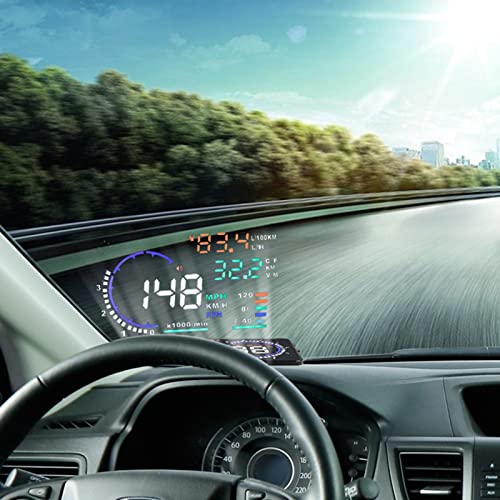
- Displays a wide range of vehicle data
- Offers several configurable warning reminders
- Supports OBD II and EUOBD systems
Best For: Drivers prioritizing alerts and detailed dashboard information
Best Simple Setup

- USB plug-and-play installation
- Uses GPS and BDS positioning
- Large-font speed display for many vehicles
Best For: Drivers wanting a basic, easy-to-install speed display
Best OBD2 Value
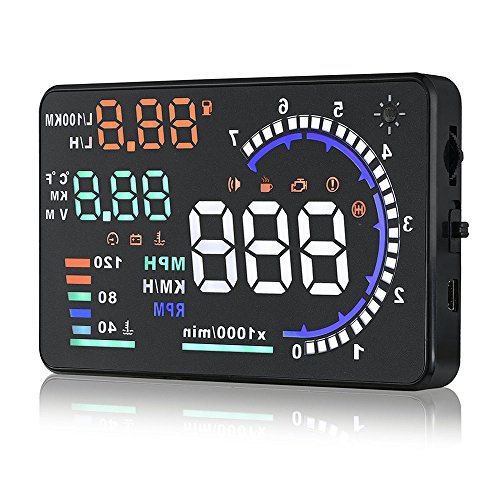
- Projects speed and engine data
- Adjustable day/night brightness
- Plug-and-play OBD2 setup
Best For: Drivers with compatible OBD2 gasoline vehicles
Best Universal GPS Pick

- USB-powered with no OBD port needed
- Large MPH display with auto brightness
- GPS and BDS positioning
Best For: Most USB-equipped cars, trucks, and motorcycles
Best Diagnostic Features
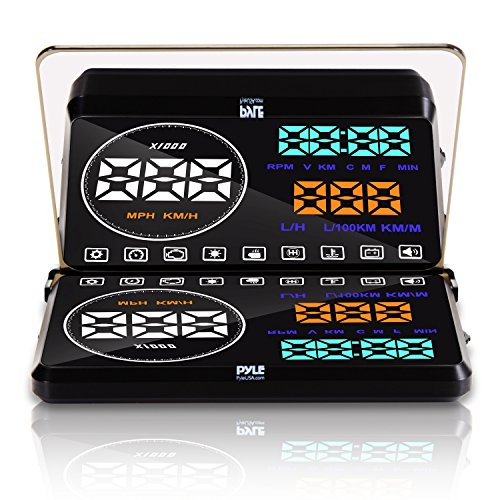
- Extensive vehicle data and diagnostics
- Multiple alerts and driving reminders
- Includes reflection film and grip mat
Best For: Drivers wanting projected speed and engine monitoring
Best GPS Plug-and-Play Pick

- GPS and BDS positioning with a 10Hz refresh rate
- USB-powered setup without an OBD connection
- Large MPH display with automatic brightness
Best For: Drivers wanting a simple GPS speedometer for several vehicle types
Best Multi-Data OBD Option
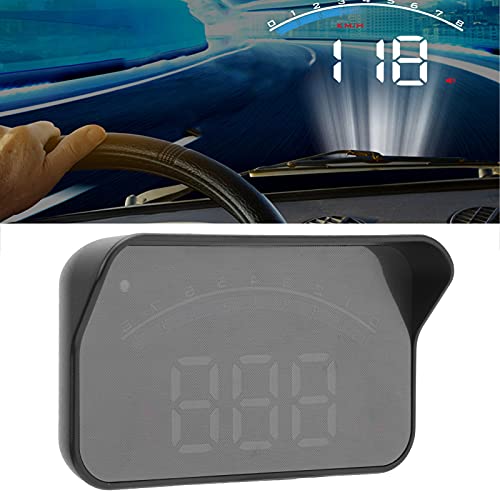
- Displays speed, RPM, voltage, and water temperature
- Includes multiple driving and vehicle alarms
- Automatic or manual brightness with glare reduction
Best For: Owners of compatible OBDII vehicles wanting broader vehicle data
Best Automatic-Dimming GPS Display

- Dual GPS and BeiDou chipsets with a 10Hz refresh rate
- Large HD speed display for quick viewing
- USB setup with automatic power and brightness features
Best For: Drivers wanting a prominent GPS speed readout with hands-off operation
Best Overall – 5.5-Inch OBD2 Car HUD
For shoppers comparing car head up displays under 100, this 5.5-inch model stands out for combining a large projected readout with OBD2 vehicle data. It displays speed, RPM, water temperature, voltage, and fuel information, while also offering alerts and diagnostic functions.
Best For: Drivers who want broad vehicle monitoring and OBD2 diagnostics in one display.
Pros:
- Large 5.5-inch HD screen with automatic brightness adjustment
- Displays speed, RPM, water temperature, voltage, and fuel consumption
- Supports fault detection, alarms, and fault-code clearing
- Plug-and-play setup for compatible OBD2/EOBD vehicles
Cons:
- Requires a compatible OBD2 or EOBD vehicle
- OBD2 installation depends on access to the vehicle’s port
This is the most feature-rich option in the group for drivers who want more than speed projection. Confirm vehicle compatibility before buying, especially if you want to use the diagnostic features.
Best GPS Option – USB GPS Heads-Up Display
This GPS-based model is a practical choice among car head up displays under 100 if you prefer USB power and do not want to use an OBD port. Its large-font speed projection uses GPS and BDS positioning, with automatic brightness adjustment for changing light conditions.
Best For: Drivers seeking a simple, USB-powered speed display for cars, trucks, or motorcycles.
Pros:
- USB plug-and-play power without requiring an OBD port
- GPS and BDS positioning with a stated 10Hz refresh rate
- Large MPH display with automatic brightness adjustment
- Compatible with vehicles equipped with a USB port
Cons:
- GPS accuracy can vary by approximately 0.6–1.8 MPH
- Signal may be affected in tunnels, garages, heavy rain, fog, or behind metallic windshield film
- Primarily provides GPS speed rather than extensive vehicle diagnostics
Choose this model when straightforward installation matters most. Its GPS operation broadens compatibility, but satellite conditions can affect performance in covered or obstructed locations.
Best Vehicle Data Alerts – 5.5-Inch Multi-Color OBD HUD
For buyers researching car head up displays under 100, this 5.5-inch OBDII/EUOBD unit offers a broad set of dashboard readings and configurable driving reminders. It projects speed and other vehicle information while providing overspeed, temperature, voltage, and fatigue-driving alerts.
Best For: Drivers who want multiple warning prompts and a wide range of OBD-read vehicle information.
Pros:
- Displays speed, engine speed, water temperature, voltage, fuel consumption, and mileage
- Includes overspeed, high-temperature, low-voltage, shift, and fatigue reminders
- Automatic and manually adjustable brightness settings
- Supports OBD II and EUOBD systems
Cons:
- Requires an OBD II or EUOBD-compatible vehicle
- The supplied notes do not specify the included components clearly
This model is appealing if alerts are as important to you as the projected speed. Its OBD connection enables richer vehicle information, but compatibility should be checked before purchase.
Best Simple Setup – Green GPS Speedometer HUD
If you want a straightforward addition to your dashboard, this green GPS speedometer is one of the simpler car head up displays under 100. It uses GPS and BDS positioning, connects through USB, and presents speed in a large, easy-to-read format for a range of vehicles.
Best For: Drivers who want a basic USB-powered speed display with large lettering.
Pros:
- USB plug-and-play design with no complex installation
- GPS and BDS positioning for real-time speed data
- Large-font display designed for quick reading
- Listed for use with cars, trucks, motorcycles, SUVs, and other vehicles
Cons:
- Focuses on speed display rather than broader vehicle diagnostics
- The supplied details do not mention automatic brightness adjustment
- GPS performance can depend on signal conditions
This is a sensible pick for buyers who want minimal setup and a dedicated speed readout. Consider a more advanced OBD model if you need engine data, alerts, or diagnostic functions.
Best OBD2 Value – 5.5-inch A8 OBD2 Car HUD
For drivers comparing car head up displays under 100, the A8 is a practical OBD2 option that projects speed and key engine information onto the windshield. Its plug-and-play setup and automatic power control make it convenient, provided your vehicle is compatible.
Best For: OBD2-compatible gasoline vehicles whose drivers want speed, RPM, temperature, voltage, and mileage information in view.
Pros:
- Displays speed, RPM, water temperature, voltage, and single mileage.
- Includes anti-ghosting reflective film and adjustable brightness.
- Automatic power-on/off follows the vehicle ignition.
Cons:
- Not compatible with several brands and select Hyundai/Kia models.
- Requires an OBD II or EUOBD gasoline vehicle.
This is a strong choice when broad vehicle data matters more than universal compatibility. Confirm your vehicle’s OBD2 support before ordering.
Best Universal GPS Pick – K1 GPS Car HUD
Among car head up displays under 100, this GPS model stands out for USB-powered installation and broad vehicle compatibility. It reads speed through GPS and BDS rather than the vehicle’s OBD port, making it useful for cars, trucks, and motorcycles with USB power.
Best For: Drivers seeking a simple, USB-powered speed display without OBD2 compatibility concerns.
Pros:
- Uses GPS and BDS positioning with a 10Hz refresh rate.
- Works with most USB-equipped cars, trucks, and motorcycles.
- Automatic brightness adjustment and large MPH display improve readability.
Cons:
- GPS speed can deviate by approximately 0.6–1.8 MPH.
- Signal may be affected in tunnels, garages, poor weather, or behind metallic windshield film.
This is the more flexible pick for buyers who mainly want projected speed. Its GPS dependence is the key trade-off, especially in areas with obstructed satellite reception.
Best Diagnostic Features – Pyle 5.5-inch OBD HUD
For shoppers browsing car head up displays under 100, the Pyle PHUD18OBD.5 offers a wide range of vehicle information and warning functions through OBDII/EUOBD integration. It is designed for plug-and-play installation and includes a reflective panel, window film, and non-slip mat.
Best For: Drivers who want projected speed plus extensive engine monitoring, reminders, and diagnostic alerts.
Pros:
- Displays speed, RPM, water temperature, voltage, fuel consumption, and distance.
- Provides over-speed, high-temperature, engine-failure, fatigue, and shift reminders.
- Offers automatic brightness balancing, MPH/KPH selection, and auto power control.
Cons:
- Compatibility is limited to supported OBDII/EUOBD vehicles.
- Provides more features than drivers seeking a basic speed-only display may need.
The Pyle is the feature-rich choice in this group, particularly for drivers who value diagnostics and alerts. Check vehicle compatibility before installation.
Best GPS Plug-and-Play Pick – Smart In-Car HUD Co-Pilot
For drivers comparing car head up displays under 100, this ATNPTN model offers a straightforward GPS-based speed reference without connecting to the vehicle’s OBD port. Its large MPH readout, USB power, and automatic brightness make it practical for commutes, highway trips, and other open-road driving.
Best For: Drivers who want a simple GPS speedometer that works across multiple USB-equipped vehicles.
Pros:
- Uses GPS and BDS positioning with a 10Hz refresh rate and support for up to 32 satellites.
- USB plug-and-play setup requires no OBD connection or wiring modification.
- Automatic brightness adjustment and an anti-reflective shade support daytime and nighttime viewing.
- Large MPH display shows speeds up to 115 MPH.
Cons:
- GPS speed can vary by approximately 0.6–1.8 MPH from other readings.
- Satellite reception may be limited indoors, in tunnels, underground garages, or behind metallic windshield film.
- Initial satellite lock typically takes 10–30 seconds in an open area.
This is a strong choice when easy installation matters more than displaying engine data. The two-year manufacturer warranty is an added advantage for buyers seeking a basic, versatile HUD speedometer.
Best Multi-Data OBD Option – M6S Universal Car HUD
Among car head up displays under 100, the M6S stands out for showing more than speed. It connects through an OBD interface and can display engine RPM, voltage, water temperature, alarms, and other vehicle information, provided the vehicle meets its compatibility requirements.
Best For: Drivers with a compatible OBDII vehicle who want engine information and warning functions in addition to speed.
Pros:
- Can display speed, engine RPM, water temperature, voltage, and fault information.
- Plug-and-play OBD connection automatically reads vehicle data when the engine starts.
- Includes speed, voltage, water-temperature, fatigue-driving, and fault alarms.
- Offers automatic or manual brightness adjustment and glare-reducing projection.
Cons:
- Requires an OBDII-compliant vehicle and careful compatibility checking.
- The supplied notes state that it is not compatible with hybrid electric vehicles, diesel vehicles, pickup trucks, sedans, or computer-modified vehicles.
- Installation depends on the vehicle’s OBD port rather than USB-only power.
The M6S is more feature-focused than a basic speed HUD, but compatibility is the deciding factor. Buyers should verify their vehicle against the listed restrictions before choosing this model.
Best Automatic-Dimming GPS Display – HD Large-Font GPS HUD
This GPS model is a practical contender among car head up displays under 100 for drivers who prioritize a prominent speed readout and minimal setup. It uses USB power, a windshield projection sticker, dual GPS and BeiDou chipsets, and automatic brightness based on GPS-recognized time.
Best For: Drivers who prefer a large-font GPS speed display with automatic power and brightness behavior.
Pros:
- Dual GPS and BeiDou chipsets plus a 10Hz refresh rate are designed for responsive speed updates.
- Large HD font makes the projected speed information easy to see at a glance.
- USB plug-and-play setup includes a projection sticker, adhesives, cable, and manual.
- Automatically powers on with the vehicle and shuts down when the engine is off.
Cons:
- Initialization and satellite synchronization may take approximately 1–3 minutes.
- Automatic dimming is described as occurring at 18:00 based on GPS time, which may not match every lighting condition.
- The supplied details do not specify a manufacturer warranty duration.
Its large display and automatic operating features make this a convenient everyday GPS HUD. The longer stated startup process is the main tradeoff for drivers who want immediate readings after turning on the vehicle.
How We Picked the Best Car Head Up Displays Under 100
We focused on the features that matter most in everyday driving: readable speed information, dependable power options, straightforward installation, adjustable brightness, and compatibility with common vehicles. GPS models generally offer the easiest setup because they do not need access to the vehicle’s diagnostic port. OBD2 models can provide more information, but their compatibility and available readings vary by vehicle.
We also considered practical details such as MPH and KM/H support, overspeed alerts, screen size, windshield projection, USB or plug-and-play operation, and whether the display includes useful data such as RPM, coolant temperature, fuel consumption, or diagnostic codes. A larger screen is not automatically better if it creates glare or blocks part of the driver’s view.
Quick Comparison
| Type | Best For | Main Advantage | Potential Limitation |
|---|---|---|---|
| GPS HUD | Simple installation | Works independently of OBD2 data | Usually shows fewer vehicle metrics |
| OBD2 HUD | Vehicle information | Can display RPM, temperature, and alerts | Compatibility depends on the vehicle |
| Large-screen HUD | At-a-glance visibility | Large numbers and clearer viewing | May take up more windshield space |
| Compact HUD | Smaller dashboards | Less intrusive installation | Smaller text may be harder to read |
Key Buying Factors for Car Head-Up Displays Under $100
GPS Versus OBD2
Choose GPS if you want the simplest setup and primarily need speed. Choose OBD2 if you want vehicle-specific information such as engine RPM, coolant temperature, or fuel-related data. Before buying an OBD2 model, check that your car has a compatible port and that the advertised functions work with its computer system.
Display Clarity and Brightness
Look for large, high-contrast digits, adjustable brightness, and a projection design that remains visible in both daylight and darkness. Anti-glare features and a supplied reflective film can improve readability, but placement still matters. Install the unit where it does not obstruct road visibility.
Power and Installation
USB-powered models are convenient for GPS operation, while OBD2 units typically connect directly to the diagnostic port. Confirm cable length, startup behavior, and whether the unit requires calibration. A model with automatic brightness or a clear overspeed alarm can be more convenient during daily use.
Units and Alerts
Make sure the display supports your preferred MPH or KM/H setting. Overspeed warnings, speeding alarms, and customizable alert thresholds can be useful, but they should supplement—not replace—attention to posted speed limits and road conditions.
Who Should Buy Which Car Head Up Displays Under 100?
- For the easiest setup: Choose a GPS HUD with USB power and a large digital speed readout.
- For more vehicle data: Choose an OBD2 model that lists the readings supported by your car.
- For bright daylight driving: Prioritize large digits, adjustable brightness, and a reflective projection surface.
- For compact interiors: Look for a smaller HUD that provides essential speed information without crowding the windshield.
- For frequent highway driving: Consider a model with a clear overspeed alarm and easy-to-read MPH display.
Before ordering, verify your vehicle’s model-year compatibility, preferred measurement units, power connection, and return policy. Staying within budget is useful, but a readable display and reliable installation are more important than having the longest feature list.