A head-up display can make everyday driving easier by placing speed, navigation, and warning information closer to your natural line of sight. The best models reduce the need to glance down at the instrument cluster or center screen.
These 10 picks cover simple GPS speedometers, OBD2 vehicle monitors, and multifunction displays with wireless CarPlay or Android Auto. Use the guide below to choose the right balance of visibility, compatibility, installation, and useful features.
Best 10 Car Head Up Displays for Daily Driving Picks for 2026
Best Diagnostic HUD

- Large 5.5-inch display with auto brightness
- Shows speed and multiple vehicle parameters
- Adds OBD2 diagnostics and warning alerts
Best For: Drivers wanting a large display with vehicle monitoring
Best Connected HUD
Wireless CarPlay and Android Auto Display

- Wireless CarPlay and Android Auto support
- Bluetooth calls, navigation, media, and voice control
- Anti-glare display with adaptive brightness
Best For: Commuters who prioritize smartphone connectivity
Best Simple GPS HUD
Dual-Mode GPS Speedometer with Clock

- Uses GPS and Beidou satellite positioning
- USB plug-and-play installation
- Shows speed, time, direction, and overspeed alerts
Best For: Drivers wanting essential GPS information without OBD2
Best Multi-Data OBD HUD
5.5-Inch Vehicle Information Display
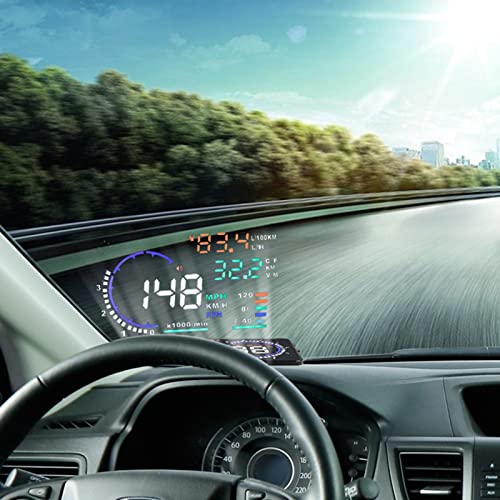
- Large display with automatic or manual brightness
- Shows multiple engine and fuel-related readings
- Includes overspeed, temperature, voltage, and fatigue reminders
Best For: Compatible OBDII/EUOBD vehicles needing broad data coverage
Best OBD2 Data-Rich Pick
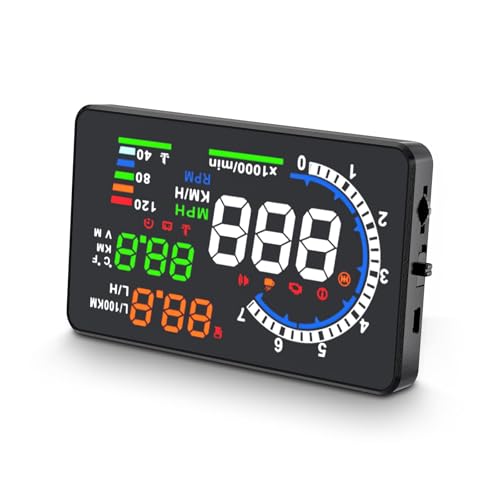
- Large 5.5-inch HD display
- Shows speed, temperature, voltage, and distance
- Adds speeding, voltage, and vehicle-fault functions
Best For: Compatible OBDII/EOBD vehicles needing a large, information-rich display
Best Universal GPS Option

- GPS operation avoids model-specific OBD limits
- Includes OBD and cigarette-lighter power cables
- Designed for broad vehicle and temperature compatibility
Best For: Older, modified, or non-OBD vehicles needing simple installation
Best Simple OBD2 Safety Display
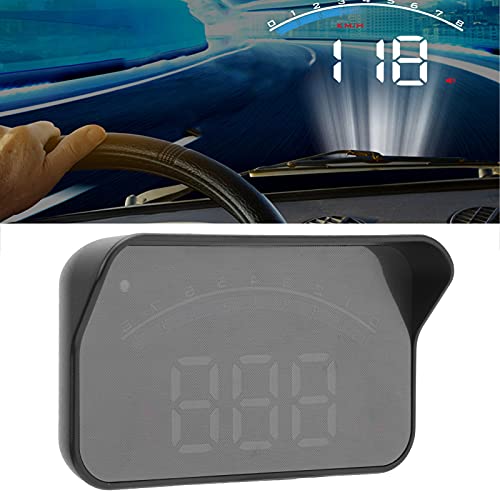
- Projects essential data toward the windshield
- Monitors up to 10 driving parameters
- Provides speeding, temperature, and voltage alerts
Best For: OBD2-equipped vehicles needing basic readings and safety reminders
Best Feature-Rich Pick

- 5.5-inch display with multiple layouts
- GPS/Beidou positioning and trip data
- USB setup with rotating bracket
Best For: Drivers wanting customizable, information-rich daily displays
Best for Simple Speed Tracking

- Large MPH display with anti-reflective shading
- Automatic brightness adjustment
- USB-powered with no OBD port required
Best For: Drivers who primarily want a clear, compact speed readout
Best Diagnostic HUD – 5.5-Inch OBD2 GPS Speedometer
For drivers comparing car head up displays for daily driving, this model stands out for its large 5.5-inch screen and broad vehicle-data coverage. It connects through an OBD2 port to show speed, RPM, water temperature, voltage, fuel consumption, and selected diagnostic information.
Best For: Drivers who want a large display plus basic OBD2 monitoring and alerts.
Pros:
- Large HD screen with automatic brightness adjustment.
- Displays speed, RPM, water temperature, voltage, and fuel data.
- Supports fault detection, failure alerts, and fault-code clearing.
- Plug-and-play setup for compatible OBD2/EOBD vehicles.
Cons:
- Requires a compatible OBD2/EOBD vehicle.
- Its wider range of vehicle data may be more than some drivers need.
This is a practical choice when visibility and vehicle information matter more than a minimal installation. Confirm your vehicle’s OBD2 compatibility before buying.
Best Connected HUD – Wireless CarPlay and Android Auto Display
This compact option combines a 2.99-inch color display with wireless CarPlay and Android Auto, making it one of the more connectivity-focused car head up displays for daily driving. It can provide navigation, calls, media, and optional OBD/GPS information while supporting voice control.
Best For: Commuters who want smartphone connectivity, navigation, and hands-free functions in a dashboard-mounted HUD.
Pros:
- Supports wireless Apple CarPlay and Android Auto.
- Provides Bluetooth calling, GPS guidance, media streaming, and voice commands.
- High-luminance anti-glare display with adaptive brightness.
- Silicone base is designed to resist shifting on rough roads.
Cons:
- The 2.99-inch screen is smaller than the displays on some alternatives.
- Wireless smartphone features may be unnecessary for drivers seeking only speed data.
Choose this model if your daily driving routine centers on navigation and phone integration. Its compact screen keeps the feature set dashboard-friendly, while the included base avoids a more involved mounting process.
Best Simple GPS HUD – Dual-Mode GPS Speedometer with Clock
For a straightforward approach to car head up displays for daily driving, this GPS model uses GPS and Beidou satellite signals to present speed, time, direction, and distance information. It powers through a vehicle USB connection and includes automatic brightness adjustment for changing conditions.
Best For: Drivers who want plug-and-play speed, time, compass, and overspeed information without OBD2 installation.
Pros:
- GPS and Beidou positioning are designed for faster, steadier satellite reception.
- USB-powered setup does not require an OBD2 connection.
- Offers four display modes, including speed, time, and compass views.
- Includes automatic brightness, three overspeed settings, and speed calibration.
Cons:
- Displays GPS-based driving information rather than the broader engine data of an OBD2 HUD.
- Requires access to a 5V USB port or compatible power adapter.
This model is a good fit for drivers seeking essential information with minimal setup. Its automatic shutoff after the vehicle is turned off also helps avoid ongoing power draw during parking.
Best Multi-Data OBD HUD – 5.5-Inch Vehicle Information Display
This 5.5-inch OBDII/EUOBD projector is suited to drivers comparing car head up displays for daily driving who want more than a basic speed readout. It can show speed, RPM, water temperature, battery voltage, fuel-consumption figures, mileage, and fault codes in front of the driver.
Best For: Drivers with a compatible OBDII or EUOBD vehicle who want broad dashboard information and multiple reminders.
Pros:
- Large windshield display with manual and automatic brightness adjustment.
- Shows speed, engine speed, temperature, voltage, fuel use, mileage, and fault codes.
- Provides overspeed, high-temperature, low-voltage, shift, and fatigue-driving reminders.
- Automatically powers on and off with the vehicle.
Cons:
- Compatibility depends on an OBDII or EUOBD vehicle system.
- The many data fields and alerts may feel busy to drivers wanting a minimalist display.
This is a strong choice for monitoring several vehicle conditions from one screen. Check the vehicle interface and confirm that its available data matches what you want to display before purchasing.
Best OBD2 Data-Rich Pick – wiiyii A8 5.5-Inch HUD
For drivers comparing car head up displays for daily driving, the wiiyii A8 stands out for its large 5.5-inch screen and broad set of vehicle readings. It connects through an OBDII or EOBD port and displays information such as speed, water temperature, voltage, and driving distance.
Best For: Drivers with compatible OBDII or EOBD vehicles who want a large display and multiple vehicle-data readouts.
Pros:
- Large 5.5-inch HD display with 800×480 resolution.
- Shows speed, water temperature, voltage, distance, and other readings.
- Includes speeding and voltage alarms, plus kilometer/mile switching.
- Can support vehicle fault detection, alerts, and fault clearing through trip-computer data.
Cons:
- Only supports OBDII and EOBD vehicles; it does not support OBD I or JOBD.
- Vehicle compatibility should be checked before purchase, particularly for older models and regional variants.
The A8 is a practical choice when screen size and diagnostic-style information matter more than universal compatibility. Confirm your car’s port standard first, then use the large display to keep common readings in view.
Best Universal GPS Option – HUD-V3 GPS Car HUD
Among car head up displays for daily driving, the HUD-V3 is designed for broad vehicle compatibility because it uses GPS rather than relying on model-specific OBD connectivity. It also supports phone pairing, offers dual power options, and is designed to remain visible across a wide temperature range.
Best For: Drivers of older, modified, new-energy, or otherwise incompatible vehicles who want a plug-and-play GPS speed display.
Pros:
- GPS-based operation is described as compatible with sedans, trucks, SUVs, RVs, and pickup trucks.
- Includes both an OBD cable and a cigarette-lighter power cable.
- Supports Bluetooth and Wi-Fi phone pairing, with CarPlay and Android Auto listed in the product title.
- Operates from -20°C to 75°C and includes overheat protection with automatic cooling-fan operation.
Cons:
- Phone setup requires Bluetooth and Wi-Fi to be enabled and paired correctly.
- The unit uses dashboard space, even though its compact design is intended to minimize obstruction.
The HUD-V3 is the most flexible pick of this group for vehicles without dependable OBD support. Its GPS approach and included power choices simplify installation, while the phone connection adds functionality for drivers willing to complete the setup.
Best Simple OBD2 Safety Display – Multifunction OBD2 HUD
This multifunction OBD2 model is a straightforward option for car head up displays for daily driving, projecting key readings toward the windshield so drivers can check them without looking down at the dashboard. It monitors up to 10 data points and provides alerts for several conditions.
Best For: OBD2-equipped vehicles whose drivers want basic windshield-projected data and audible safety reminders.
Pros:
- Displays speed, water temperature, voltage, fuel consumption, and mileage in real time.
- Supports kilometer/mile and Celsius/Fahrenheit switching.
- Provides voice alerts for speeding, abnormal water temperature, and low voltage.
- Compact ABS-and-glass construction is designed for in-car use and long-term durability.
Cons:
- Requires a vehicle equipped with an OBD2 interface.
- The supplied notes do not specify the display size or resolution.
- Its feature set is focused on vehicle readings and reminders rather than phone-based navigation or media.
This HUD makes sense for drivers who want essential vehicle information and warning prompts without a larger entertainment-oriented system. Verify OBD2 compatibility, then use the selectable units and alerts to tailor it to everyday driving.
Best Feature-Rich Pick – HUD G12
For drivers comparing car head up displays for daily driving, the HUD G12 stands out for its broad set of trip and navigation readouts. Its 5.5-inch screen, GPS/Beidou positioning, and USB plug-and-play setup make it a flexible choice for everyday use.
Best For: Drivers who want speed, trip, direction, and driving-alert information in one adjustable display.
Pros:
- Displays speed, time, trip mileage, driving direction, latitude, longitude, and additional trip data.
- Offers more than ten display combinations for personalized viewing.
- Uses GPS and Beidou dual-mode positioning for faster satellite searching.
- Includes a 360-degree rotating bracket and one-year warranty.
Cons:
- The larger 5.5-inch design may take up more dashboard space than compact alternatives.
- Its many display options may require more setup than a basic speed-only HUD.
The G12 is a practical fit if you value customization and multiple driving metrics over a minimalist display. USB power and flexible mounting also make installation straightforward.
Best for Simple Speed Tracking – K1 GPS HUD
If you want car head up displays for daily driving focused mainly on speed, the K1 keeps the readout large and easy to scan. It combines GPS/BDS positioning with automatic brightness adjustment and USB power, without requiring an OBD connection.
Best For: Drivers seeking a compact, readable speed display for cars, trucks, or motorcycles with a USB port.
Pros:
- Uses GPS and BDS with a 10Hz refresh rate and support for up to 32 satellites.
- Provides a large-font MPH display with anti-reflective metal shading.
- Automatically adjusts brightness for daytime and nighttime conditions.
- USB-powered and compatible with many 5V-equipped vehicles without an OBD port.
Cons:
- GPS speed can vary by approximately 0.6–1.8 MPH.
- Satellite reception may be affected by tunnels, garages, weather, or metallic windshield film.
- The supplied notes specify speed display rather than a broad set of trip metrics.
The K1 is a strong everyday option when quick speed visibility matters most. Its compact body and automatic brightness are especially useful for drivers who prefer a straightforward display.
Best Windshield Projection – MAIMEIMI M1 HUD
Among car head up displays for daily driving, the MAIMEIMI M1 is designed for direct windshield projection rather than relying only on a separate display surface. It adds travel direction, overspeed alerts, and a fatigue reminder while using USB power in 5V vehicles.
Best For: Drivers who want a projected speed readout with brightness control and basic driving alerts.
Pros:
- Projects large speed information onto the windshield while maintaining a relatively clear forward view.
- Includes travel direction, overspeed alarm, and fatigue alarm functions.
- Automatically adjusts brightness through a built-in light sensor, with manual adjustment also available.
- Offers plug-and-play USB operation and a one-year warranty.
Cons:
- Requires a 5V power supply; a higher voltage can damage the unit.
- Initial satellite searching may take longer in enclosed or obstructed locations.
- Another GPS device in the vehicle may interfere with signal searching.
The M1 is appealing if windshield projection and reminder alarms are more important than displaying numerous trip statistics. Allow time for satellite acquisition and follow the 5V power requirement carefully.
How We Picked the Best Car Head Up Displays for Daily Driving
We focused on displays that provide practical information during regular commutes, errands, and road trips. The selection includes GPS-based units that work across many vehicles, OBD2 models that can show vehicle data, and multifunction HUDs with smartphone connectivity. We also considered screen size, installation method, speed-unit support, overspeed alerts, readability, and the amount of information shown at once.
Because product specifications and vehicle compatibility can vary, confirm the listing details before buying. In particular, check whether your vehicle has a compatible OBD2 or EUOBD port and whether the display supports your preferred phone and navigation setup.
Quick Comparison
| Type | Best For | Main Advantage | Potential Limitation |
|---|---|---|---|
| GPS speedometer HUD | Simple speed display | Broad vehicle compatibility | May show less vehicle data |
| OBD2 HUD | Vehicle information | Can access engine and driving data | Requires a compatible diagnostic port |
| CarPlay or Android Auto HUD | Connected navigation and media | Combines phone features with driving information | More setup and screen complexity |
| Large-screen projector | Easy readability | Clearer numbers at a glance | Can take up more dashboard or windshield space |
Key Buying Factors for Car Head-Up Displays for Daily Driving
Power and Vehicle Compatibility
GPS units generally connect through USB and calculate speed from satellite signals, making them a flexible option for many cars. OBD2 models plug into the vehicle’s diagnostic socket and may provide additional information such as engine speed, coolant temperature, voltage, or fault alerts. Verify the port location and protocol before choosing an OBD2 display.
Visibility and Projection Quality
Look for large, high-contrast numbers, adjustable brightness, and support for both MPH and KM/H if you drive across regions. A reflective film or suitable dashboard mat can improve projection clarity, while automatic brightness adjustment is useful when driving from daylight into darker conditions.
Information and Distractions
A good daily-driving HUD should make essential information quicker to see, not create another complicated screen. Speed, direction, navigation prompts, and overspeed warnings are often more useful than a crowded collection of metrics. Choose a layout you can read briefly without losing attention from the road.
Installation and Reliability
USB-powered units are usually straightforward to install, but cable placement matters. Secure the device and route wires away from controls, airbags, and the driver’s view. GPS performance can be affected by tunnels, tall buildings, and severe weather, while OBD2 displays depend on a stable connection to the vehicle.
Who Should Buy Which Car Head Up Displays for Daily Driving?
Choose a GPS speedometer HUD if you want a simple, broadly compatible speed readout with minimal installation. Select an OBD2 model if you want deeper vehicle information and your car supports the required connection. A CarPlay or Android Auto model is better for drivers who want navigation, calls, and media controls in one connected display. For older drivers or anyone who values fast readability, prioritize a larger screen, adjustable brightness, and uncluttered alerts. For frequent commuters, reliability, stable mounting, and easy-to-read speed information should matter more than extra features.