A dual-mode car head-up display can put essential driving information—such as speed, engine readings, and warnings—closer to your natural line of sight. The products in this roundup combine OBD2 and GPS connectivity in different ways, giving drivers more flexibility across vehicle types.
Below, compare display size, supported data, installation requirements, visibility, and everyday usability to find the right HUD for your car and driving habits.
Best 10 Dual Mode Car Head Up Displays Picks for 2026
Best Feature-Rich Pick

- Displays extensive engine and driving data
- Gesture control, alerts, RGB lighting, and themes
- Includes acceleration and braking performance tests
Best For: Feature-focused drivers who want detailed vehicle monitoring
Best for Diagnostics

- Monitors multiple engine and trip parameters
- Scans and clears engine fault codes
- Provides adjustable alerts and GPS fallback
Best For: Supported OBDII/EOBD vehicles needing monitoring and fault-code tools
Best Value OBD Display

- Plug-and-play OBD II/EUOBD compatibility
- Shows core engine and vehicle readings
- Includes temperature, voltage, and speed alarms
Best For: Drivers wanting essential OBD information without advanced features
Best Dual-Mode Value
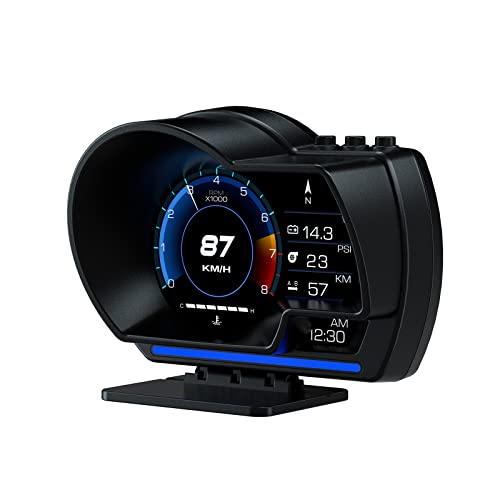
- Combines OBD2 and GPS modes
- Shows speed plus extensive vehicle data
- Includes dashboard and windshield mounting options
Best For: Drivers wanting broad vehicle information and GPS backup
Best Simple Speed Display

- Projects large real-time speed figures
- Plug-and-play USB installation
- Includes long cable and reflective-film accessories
Best For: Drivers seeking a basic, readable speed display
Best Dual-View Projection

- Switches between front display and projection
- Shows speed and temperature at a glance
- Uses direct OBD2 setup for compatible 12V vehicles
Best For: Drivers wanting flexible dual-screen viewing
Best GPS Pick

- GPS+BDS positioning with 10Hz refresh
- USB-powered without an OBD port
- Large display with automatic brightness
Best For: Simple GPS speed projection across USB-equipped vehicles
Best Data-Rich Option

- Large HD display with auto brightness
- Shows speed plus key vehicle data
- Adds OBD2 diagnostics and alerts
Best For: Compatible vehicles needing speed, gauges, and diagnostic information
Best Compact Alternative
- GPS+BDS speed tracking at 10Hz
- USB plug-and-play installation
- Compact, large-font display with auto brightness
Best For: Lightweight GPS speed monitoring without OBD connectivity
Best Feature-Rich Pick – OBD2+GPS Dual-Mode HUD
For drivers comparing dual mode car head up displays, this OBD2+GPS model stands out for its broad data coverage, customizable interface, and hands-free gesture control. In OBD2/EOBD mode, it displays speed, RPM, coolant temperature, voltage, fuel consumption, compass, turbo pressure, and altitude, while GPS mode provides an alternative connection method.
Best For: Drivers who want extensive vehicle data, configurable alerts, and a more feature-rich dashboard display.
Pros:
- Shows numerous driving and engine metrics in OBD2/EOBD mode.
- Offers 13 UI themes, 15 languages, 68 car logos, and calibration settings.
- Includes proximity gesture control, overspeed and temperature alerts, and RGB lighting.
- Supports acceleration and braking performance tests.
Cons:
- Full data coverage is available only in OBD2/EOBD mode.
- Its many settings and displayed metrics may be more than some drivers need.
With its 3.5-inch screen, rotating bracket, and included OBD cable and anti-slip mat, this is a versatile choice for buyers prioritizing customization and diagnostics over simplicity.
Best Simple GPS Option – Large-Font GPS Car HUD
This GPS-based option is a straightforward choice among dual mode car head up displays, using GPS and BDS satellite technology rather than an OBD connection. Its large speed readout, USB plug-and-play setup, adjustable brightness, and MPH/KM/H switching make it practical for everyday speed monitoring.
Best For: Drivers who want a simple, readable GPS speed display with minimal installation.
Pros:
- Uses GPS+BDS technology with a stated 10Hz refresh rate and support for up to 32 satellites.
- Installs by plugging into a USB power source.
- Provides MPH/KM/H switching, speed calibration, and adjustable brightness.
- Includes a customizable overspeed warning and large anti-reflective display.
Cons:
- GPS performance can be affected in tunnels, underground garages, heavy rain, fog, or behind metallic windshield film.
- Its listed functions focus primarily on speed rather than engine diagnostics.
This compact HUD is best suited to buyers who value quick setup and an easy-to-read speed display instead of extensive OBD2 vehicle data.
Best for Diagnostics – OBD2+GPS Gauge Display
For buyers evaluating dual mode car head up displays with diagnostic capabilities, this model combines OBD2 vehicle data with GPS fallback functionality. It can show speed, tachometer readings, water temperature, voltage, fuel consumption, turbo pressure, altitude, compass, and other trip information, while also scanning and clearing engine fault codes.
Best For: OBDII/EOBD vehicle owners who want dashboard monitoring plus basic fault-code functions.
Pros:
- Reads and displays a wide range of real-time OBD2 data.
- Can scan and clear engine fault codes and perform acceleration and brake tests.
- Offers separate OBD2 and GPS modes, with customizable units, brightness, interfaces, and alerts.
- Provides adjustable alarms for speed, temperature, voltage, and RPM.
Cons:
- OBD2 compatibility is limited to qualifying OBDII/EOBD vehicles generally produced after 2008.
- The notes list several incompatible vehicle types and brands.
- On incompatible OBD2 protocols, only GPS functions are available.
Compatibility should be checked carefully before purchase, but for supported vehicles this display offers a useful combination of live gauges, configurable warnings, and basic diagnostic tools.
Best Value OBD Display – Universal Multi-Mode HUD
This affordable-looking multi-mode unit is a basic entry in the dual mode car head up displays category, using OBD II or EUOBD connectivity with plug-and-play installation. Its 3-inch high-definition screen presents core readings such as speed, engine RPM, water temperature, and battery voltage.
Best For: Drivers who want a straightforward OBD-based display for essential vehicle readings and alerts.
Pros:
- Automatically adapts to compatible OBD II or EUOBD vehicles.
- Displays speed, engine RPM, water temperature, and battery voltage.
- Includes low-voltage, high-temperature, and speed alarms.
- Supports kilometer/mile and Celsius/Fahrenheit switching with automatic power control.
Cons:
- The notes do not specify GPS functionality or a separate GPS operating mode.
- It provides fewer listed features and less customization than the more advanced models here.
Choose this model if you want core OBD readings in a compact display and do not need extensive diagnostics, GPS tracking, or advanced interface options.
Best Dual-Mode Value – wiiyii P6 OBD2/GPS HUD
For shoppers comparing dual mode car head up displays, the wiiyii P6 stands out for combining OBD2 and GPS data in one compact gauge. It can show speed and other vehicle information, while its adjustable brightness and overspeed color alert help keep key readings visible without looking down at the instrument cluster.
Best For: Drivers who want broad vehicle data, GPS backup, and flexible dashboard or windshield installation.
Pros:
- Uses OBD2 and GPS modes together, with GPS-only operation for vehicles without the required OBD2 protocol.
- Displays a wide range of information, including speed, voltage, fuel consumption, RPM, water temperature, and fault codes.
- Includes an adjustable bracket, suction cup, 3M tape, and automatic brightness adjustment.
- Changes its ambient light from blue to red for an overspeed warning.
Cons:
- The larger feature set may be more than drivers who only need a basic speed display require.
- OBD2 data availability depends on the vehicle’s compatibility.
The P6 is the most versatile option here for buyers who want more than speed. Its dual-mode design and extensive readouts make it a practical choice for monitoring vehicle information, though a simpler HUD may be preferable for minimalists.
Best Simple Speed Display – Large-Font USB GPS HUD
Among dual mode car head up displays, this model is a straightforward choice for drivers focused on speed visibility. Its large-font display projects real-time speed onto the windshield, while the USB plug-and-play setup and automatic power control keep installation simple.
Best For: Drivers who primarily want a clear, easy-to-install digital speedometer for everyday use.
Pros:
- Uses a high-brightness, large-font display designed for quick reading.
- Includes a 6.6-foot USB cable for flexible placement and routing.
- Offers plug-and-play installation with automatic on/off operation.
- Package includes an anti-slip pad, reflective film, and film applicator.
Cons:
- The supplied notes identify speed display as the primary function, rather than a broad set of vehicle gauges.
- Its listed manufacturer warranty is limited to 30 days from purchase.
This HUD makes the most sense when readability and uncomplicated setup matter more than advanced diagnostics. It is a leaner alternative to feature-heavy models, with a large display and long cable doing most of the practical work.
Best Dual-View Projection – Dual-Screen Linkage HUD
This dual-screen HUD is a strong fit for shoppers seeking dual mode car head up displays with two viewing options. It connects through OBD2 and lets drivers switch between the front display and floating windshield projection, with speed, temperature, and additional vehicle readings available for compatible 12V vehicles.
Best For: Drivers who want both a conventional unit display and floating windshield projection in one device.
Pros:
- Offers dual-screen linkage with front display and floating projection modes.
- Projects speed and temperature onto the windshield for at-a-glance viewing.
- Connects directly to the OBD2 port without complex wiring or tools.
- Designed for most OBD2 vehicles made after 2004 in the US and after 2008 globally.
Cons:
- Compatibility is intended for vehicles with the stated OBD2 and 12V requirements.
- The supplied notes do not specify automatic brightness control or GPS operation.
The dual-view design gives this model a useful point of difference: drivers can choose a standard screen or floating projection. It is best suited to compatible vehicles where switching display styles is more important than GPS fallback or extensive diagnostic coverage.
Best GPS Pick – Dual-Mode USB Car HUD
For drivers comparing dual mode car head up displays, this compact GPS HUD focuses on clear speed projection without requiring an OBD connection. Its GPS+BDS positioning, 10Hz refresh rate, and automatic brightness adjustment make it a straightforward choice for everyday speed monitoring.
Best For: Drivers who want a simple, USB-powered windshield speed display for cars, trucks, or motorcycles.
Pros:
- Dual-mode GPS+BDS positioning connects with up to 32 satellites and refreshes at 10Hz.
- USB 5V plug-and-play power works with vehicles that have a USB port, without using the OBD port.
- Large MPH display, anti-reflective shading, and automatic brightness adjustment support daytime and nighttime readability.
Cons:
- GPS accuracy can vary by approximately 0.6–1.8 MPH.
- Satellite reception may be affected in tunnels, underground garages, severe weather, or vehicles with metallic windshield film.
This is a focused, easy-to-install HUD rather than a vehicle-diagnostics display. Choose it if accurate-enough GPS speed projection and broad USB compatibility matter more than engine data.
Best Data-Rich Option – 5.5-Inch OBD2 Car HUD
Among dual mode car head up displays, this 5.5-inch OBD2 model is aimed at drivers who want more than speed. It combines windshield projection with vehicle data such as RPM, water temperature, voltage, and fuel consumption, plus diagnostic and alert functions.
Best For: Car owners with compatible OBD2 or EOBD vehicles who want a large display and multiple vehicle readings.
Pros:
- Large 5.5-inch HD screen with automatic brightness adjustment for day and night use.
- Displays MPH or KMH, RPM, water temperature, voltage, and fuel consumption.
- OBD2 functions include fault detection, failure alerts, and failure-code clearing.
- Plug-and-play setup is designed for widely used OBD2/EOBD vehicles, generally after 2003.
Cons:
- Requires a compatible OBD2 or EOBD vehicle and an available OBD2 port.
- Its broader feature set may be unnecessary for drivers who only need speed.
This is the stronger choice for monitoring vehicle information at a glance, provided your vehicle supports the stated protocols. It offers substantially more data than a basic GPS-only HUD, but compatibility should be checked first.
Best Compact Alternative – Dual-Mode GPS Car HUD
This compact option gives dual mode car head up displays a practical, minimalist treatment. It uses GPS+BDS positioning to project speed onto the windshield, while USB power and automatic brightness adjustment keep installation and daily use simple.
Best For: Drivers seeking a lightweight, large-font GPS speedometer with USB plug-and-play operation.
Pros:
- Dual-mode GPS+BDS technology supports fast, stable speed tracking with a 10Hz refresh rate.
- USB 5V operation avoids dependence on an OBD port and suits many cars, trucks, and motorcycles.
- Automatic brightness control and anti-reflective shading help maintain visibility in changing light.
Cons:
- It primarily provides GPS speed information rather than the broader engine data available from an OBD2 HUD.
- GPS reception can be temporarily reduced in tunnels, garages, heavy rain or fog, and behind metallic windshield film.
- A small GPS speed deviation of about 0.6–1.8 MPH is possible.
With its small footprint and simple USB setup, this model suits buyers who want a dedicated speed display without diagnostic complexity. Its performance depends on clear satellite reception, so it is best for normal open-road use.
How We Picked the Best Dual Mode Car Head Up Displays
We focused on HUDs that offer dual connectivity through OBD2 and GPS, since this combination can provide both vehicle data and speed information when one signal is unavailable or unsuitable. We also considered installation simplicity, screen readability, projection style, available gauges, warning functions, and compatibility claims.
Because vehicle support varies, the most important step is confirming that your car has a compatible OBD2 port and that the display supports its model year, fuel type, and data protocol. GPS-only operation may be more broadly compatible, but it typically provides fewer engine metrics than an OBD2 connection.
Quick Comparison
Choose a compact plug-and-play model if you want basic speed and warning information without a complicated setup. Larger-screen options are better when readability is a priority, especially for drivers who want MPH or KM/H shown prominently. Models listing tachometer, coolant temperature, voltage, fault codes, or overspeed alarms are more useful for monitoring vehicle condition, provided your car exposes those readings through OBD2.
GPS-based displays generally require dashboard placement and a clear view of the sky for reliable positioning. Windshield projection models can feel more natural, but brightness, reflection, and mounting position affect how easily the information can be read.
Key Buying Factors for Dual Mode Car Head Up Displays
Compatibility and Connection
Check whether the unit supports your vehicle before buying. OBD2 compatibility is not universal across every car, and some models may require a specific protocol. A dual-mode unit is most valuable when it can switch between OBD2 and GPS instead of relying on only one connection.
Display Readability
Look for large digits, adjustable brightness, clear color contrast, and automatic day/night behavior. A display that is technically feature-rich is less useful if glare or small text makes it difficult to read at a glance.
Information and Alerts
Decide which data you actually need. Basic drivers may only want speed and overspeed alerts, while enthusiasts may prefer RPM, coolant temperature, battery voltage, fuel information, or diagnostic warnings. More metrics can also mean a busier screen.
Installation and Placement
Plug-and-play OBD2 units are usually straightforward, while GPS models may need time to acquire a signal. Position the device where it does not block your view, interfere with airbags, or create distracting reflections.
Who Should Buy Which Dual Mode Car Head Up Displays?
Buy a compact dual-mode display if you want a simple speed reference and flexible installation. Choose a large-font or 5.5-inch-style screen if visibility is your top concern. Drivers interested in vehicle monitoring should prioritize models with clearly listed OBD2 gauges and alarms. If compatibility is uncertain, favor a unit with GPS speed support and verify return policies before purchase.