A good head-up display can put speed, navigation cues, and driving alerts closer to your line of sight, reducing the need to look down at the dashboard. GPS-based models are especially useful when you want straightforward installation without relying on a vehicle’s factory display.
This roundup compares 10 GPS car head-up displays, including large-screen units, OBD2-compatible gauges, wireless models, and options with CarPlay or Android Auto. Use the guide below to narrow the choices by compatibility, visibility, features, and installation style.
Best 10 Gps Car Head Up Displays Picks for 2026
Large-Screen Safety Monitor

- Large display shows speed and multiple driving details
- Overspeed and fatigue-driving alerts
- Automatic brightness adjustment
Best For: Drivers wanting a large, data-rich GPS speedometer
OBD Data Specialist
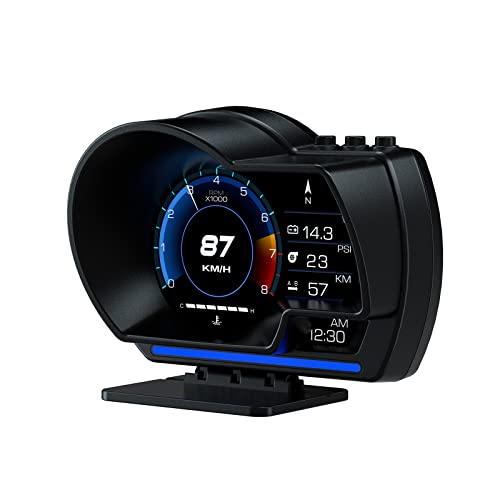
- OBD2 and GPS operation
- Displays extensive vehicle data
- Red overspeed warning and flexible mounting
Best For: Drivers who want speed plus OBD vehicle information
Simple Plug-In Display

- MPH/KMH speed and AM/PM clock
- USB plug-and-play installation
- QC3.0 charger and long cable included
Best For: Drivers wanting basic speed and time information
Connected All-Vehicle HUD

- CarPlay and Android Auto support
- OBD and cigarette-lighter power options
- Broad compatibility with thermal protection
Best For: Drivers wanting smartphone integration and flexible installation
Solar Value Pick

- Shows speed, time, temperature, and altitude
- Solar and USB power options
- Overspeed and fatigue-driving reminders
Best For: Drivers wanting solar charging and extra vehicle data
Precision Speed Pick

- Dual GPS+BDS positioning with 10Hz refresh
- Large MPH speed display
- USB-powered with automatic brightness
Best For: Drivers wanting a dedicated speed display
Connected Display Pick

- Wireless Apple CarPlay and Android Auto
- HD anti-reflection display
- Bluetooth audio and hands-free calling
Best For: Drivers seeking smartphone connectivity in older vehicles
Best Simple Setup

- USB-powered with no OBD port required
- Uses GPS plus BDS positioning at a 10Hz refresh rate
- Large speed display with automatic brightness
Best For: Drivers wanting a simple speed-only HUD with broad compatibility
Best Large Display

- Features a large 5.5-inch HD display
- Shows speed, RPM, temperature, voltage, and fuel use
- Adds OBD2 fault detection and code clearing
Best For: Drivers prioritizing screen size and vehicle monitoring
Large-Screen Safety Monitor – SinoTrack 5.5-Inch GPS HUD
For drivers comparing GPS car head up displays, the SinoTrack stands out with its extra-large 5.5-inch screen and dedicated GPS speed readout. It shows speed, driving time, mileage, time, direction, and satellite information, while automatic brightness adjustment helps keep the display readable in changing light.
Best For: Drivers who want a large, information-rich GPS speedometer with overspeed and fatigue reminders.
Pros:
- Displays speed, direction, time, mileage, driving time, and satellite data.
- Includes adjustable overspeed and four-hour fatigue-driving alerts.
- Automatic light-sensitive brightness adjustment supports daytime and nighttime viewing.
- One-button operation and a dual-core processing design are intended to keep data responsive.
Cons:
- It operates on 5V power; using a higher voltage is prohibited.
- Mileage does not accumulate or remain stored when the vehicle is powered off.
- The large screen may take up more dashboard space than compact HUDs.
This is a strong choice when visibility and driving reminders matter more than a minimalist display. Its broad readout is useful for long trips, but buyers should plan the power connection carefully and understand the mileage limitation.
OBD Data Specialist – wiiyii P6 Dual-Mode HUD
The wiiyii P6 is a versatile option among GPS car head up displays because it combines GPS with OBD2 vehicle data. Its digital speed readout, multiple interfaces, adjustable mounting options, and color-changing overspeed warning make it suitable for drivers who want more than speed alone.
Best For: Drivers seeking a dual-mode HUD with vehicle diagnostics and adjustable installation.
Pros:
- Combines OBD and GPS modes and can display speed, voltage, fuel consumption, RPM, and water temperature.
- Offers 10 interfaces and can read more than 100 types of OBD data.
- Includes dashboard and windshield mounting options with an adjustable bracket.
- Ambient lighting changes from blue to red for overspeed alerts.
Cons:
- Vehicles without the OBD2 protocol receive GPS functionality only.
- The broader data set may be more than needed for buyers seeking a simple speed display.
- OBD-based features depend on the vehicle’s available data and compatibility.
Choose the P6 if diagnostic information is a priority and your vehicle supports OBD2. Its GPS fallback broadens compatibility, but the most extensive readouts are tied to the car’s OBD system.
Simple Plug-In Display – V15 GPS HUD With Clock
For shoppers who prefer straightforward GPS car head up displays, this V15 model focuses on the essentials: a digital speedometer, clock, and simple USB-powered operation. It supports MPH or KM/H and includes a long USB cable plus a QC3.0 charger for flexible power connection.
Best For: Drivers wanting a basic speed-and-clock display for cars, trucks, boats, SUVs, golf carts, and other vehicles.
Pros:
- Shows speed in either KM/H or MPH alongside an AM/PM clock.
- Plug-and-play USB design works with the vehicle ignition.
- Includes a 6.6-foot USB cable and QC3.0 fast charger.
- Designed for use across cars, trucks, SUVs, boats, motorcycles, and golf carts.
Cons:
- Its supplied features are focused on speed and time rather than advanced vehicle data.
- USB power requires a suitable connection in the vehicle.
- As a GPS display, performance depends on obtaining a usable GPS signal.
This V15 is a practical pick for buyers who want quick installation and a clean, limited readout. It avoids complicated setup, though drivers seeking alerts, diagnostics, or navigation-style features should consider a more advanced HUD.
Connected All-Vehicle HUD – HUD-V3 With CarPlay
The HUD-V3 expands the typical GPS car head up display with CarPlay and Android Auto support, overspeed alerts, and phone connectivity through Bluetooth and Wi-Fi. It offers OBD or cigarette-lighter power options and is designed for broad vehicle compatibility, including older, modified, and newer-energy vehicles.
Best For: Drivers who want a connected HUD with smartphone integration and flexible power options.
Pros:
- Supports CarPlay and Android Auto alongside GPS speedometer functionality.
- Includes both OBD and cigarette-lighter power cables.
- Works with sedans, trucks, SUVs, RVs, pickups, older vehicles, and vehicles without OBD connectivity.
- Designed for temperatures from -20°C to 75°C, with overheat protection and an automatic cooling fan.
Cons:
- Phone integration requires Bluetooth and Wi-Fi to be enabled and paired correctly.
- OBD power automatically shuts off after 10–15 minutes when parked, then uses vibration sensing to wake.
- The connected feature set may require more setup than a basic GPS-only display.
This model is best suited to buyers who want a multifunction dashboard companion rather than a standalone speed readout. Its dual power options and broad compatibility are useful, while smartphone pairing adds convenience at the cost of a more involved setup.
Solar Value Pick – Multifunction GPS Car HUD
This solar-powered option is a practical choice among gps car head up displays for drivers who want speed information plus useful vehicle data. Its LCD screen shows speed, time, temperature, and altitude, while GPS positioning helps improve displayed-speed accuracy.
Best For: Drivers seeking a solar-assisted display with extra trip and vehicle information.
Pros:
- Displays speed, time, temperature, and altitude in one screen.
- Supports both solar charging and USB power.
- Large LCD numerals are designed for easy viewing.
- Includes adjustable overspeed and fatigue-driving reminders.
Cons:
- Its GPS-based readings may depend on signal conditions.
- The display is focused on vehicle data rather than navigation or smartphone integration.
Choose this model if solar charging and multiple readouts matter more than wireless phone features. It offers a broad feature set in a compact ABS housing.
Precision Speed Pick – High-Refresh GPS HUD
For drivers comparing gps car head up displays primarily by speed readability, this USB-powered HUD emphasizes fast GPS tracking and a large projected readout. Dual-mode GPS+BDS positioning, 10Hz refresh, and automatic brightness adjustment support clear viewing in changing light.
Best For: Drivers who want a dedicated, easy-to-read GPS speed display without using an OBD port.
Pros:
- Uses GPS and BDS with a 10Hz refresh rate and support for up to 32 satellites.
- Large MPH display is designed to stay readable at a glance.
- Automatic brightness adjustment helps balance daytime and nighttime visibility.
- USB plug-and-play power works with compatible cars, trucks, and motorcycles.
Cons:
- Speed may vary by approximately 0.6–1.8 MPH.
- GPS performance can be affected by tunnels, garages, weather, or metallic windshield film.
- It displays speed rather than smartphone navigation or media features.
This is a focused choice for buyers who value speed accuracy, quick refresh, and simple USB installation. Open-sky driving conditions should provide the strongest GPS reception.
Connected Display Pick – Wireless CarPlay HUD
This VIVIHUD model takes gps car head up displays beyond standalone speed readouts by adding wireless Apple CarPlay and Android Auto. It combines an HD screen with navigation, music, calls, screen mirroring, Bluetooth audio, and a plug-and-play setup for vehicles without built-in CarPlay.
Best For: Drivers who want smartphone connectivity and a larger smart display in older or compatible vehicles.
Pros:
- Supports wireless Apple CarPlay and Android Auto for maps, media, calls, and messages.
- Offers HD anti-reflection viewing for daylight, tunnels, rain, and nighttime use.
- Includes screen mirroring, Bluetooth audio, and hands-free calling.
- Adjustable viewing angle and a non-slip base support flexible placement.
Cons:
- Smartphone compatibility and setup are required for the connected features.
- It is a dashboard display rather than a simple standalone GPS speedometer.
- The supplied notes do not specify the included display’s dimensions or GPS refresh rate.
Consider this option when navigation and phone integration are priorities. Its universal vehicle positioning and included power cord make it especially appealing for older vehicles lacking factory CarPlay.
Most Versatile – MAIMEIMI Dual-Mode OBD2/GPS HUD
For drivers comparing gps car head up displays, the MAIMEIMI stands out for combining GPS speed tracking with OBD2 vehicle data. It can show speed alongside engine information, alerts, and turn indications, though OBD2 compatibility should be confirmed before purchase.
Best For: Drivers who want navigation assistance plus detailed vehicle monitoring.
Pros:
- Offers both OBD2 and GPS operating modes.
- Displays more than 15 metrics, including RPM, water temperature, voltage, mileage, and turbo pressure.
- Supports turn indication through its companion app.
- Includes customizable overspeed, overheating, voltage, and RPM alerts.
Cons:
- OBD2 mode is not compatible with several listed vehicle brands, hybrids, diesel vehicles, pickups, and RVs.
- GPS readings can be affected in tunnels, underground parking areas, and locations with weak satellite signals.
- App-supported turn indication requires downloading the app and meeting its device-version requirements.
This is the most feature-rich option of the three, especially for owners who want diagnostics and driving data rather than speed alone. Check your vehicle’s OBD2 compatibility, or rely on GPS mode for broader vehicle coverage.
Best Simple Setup – K1 USB GPS Speedometer HUD
If you want gps car head up displays without using the vehicle’s diagnostic port, this USB-powered K1 model offers a straightforward alternative. Its GPS and BDS positioning system focuses on displaying speed clearly, with automatic brightness adjustment for changing light conditions.
Best For: Drivers seeking a simple, broadly compatible speed-only HUD.
Pros:
- Uses USB 5V power and does not require an OBD port.
- Dual-mode GPS and BDS positioning connects with up to 32 satellites and refreshes at 10Hz.
- Large-font speed display is designed for easy reading.
- Automatic brightness adjustment helps accommodate daytime and nighttime driving.
Cons:
- Displays speed rather than the broader engine metrics offered by the other products.
- GPS speed can vary by approximately 0.6–1.8 MPH.
- Signal performance may decline in tunnels, underground garages, heavy rain or fog, or behind metallic windshield film.
The K1 is a practical pick when plug-and-play installation and wide vehicle compatibility matter most. It is less suitable if you want OBD2 diagnostics or engine information.
Best Large Display – 5.5-Inch OBD2/GPS Car HUD
Among gps car head up displays, this model emphasizes visibility with a 5.5-inch HD screen while adding OBD2 vehicle information. It projects speed and displays metrics such as RPM, water temperature, voltage, and fuel consumption, making it useful for drivers who prefer more data at a glance.
Best For: Drivers who prioritize a large display and OBD2 monitoring features.
Pros:
- Uses a large 5.5-inch HD display with automatic brightness adjustment.
- Shows GPS speed in MPH or KMH along with RPM, water temperature, voltage, and fuel consumption.
- Includes overspeed and voltage anomaly alerts.
- Offers failure detection, failure alarms, and failure-code clearing through OBD2.
Cons:
- Requires an OBD2/EOBD-compatible vehicle for its primary plug-and-play setup.
- Its larger display may be less discreet than smaller HUD units.
- Vehicle data and diagnostic functions depend on the car’s supported OBD2 information.
This is a strong choice for drivers who want a highly visible screen and more than basic speed projection. Confirm that your vehicle supports the required OBD2 or EOBD protocol before buying.
How We Picked the Best Gps Car Head Up Displays
We selected models representing the main types of aftermarket HUDs: GPS-only displays, OBD2 gauges, dual-system units, solar-powered designs, and smart screens with smartphone integration. We focused on practical differences that affect daily use, including screen size, speed accuracy, installation method, alert functions, power requirements, and compatibility with different vehicles.
Because vehicle electronics vary, buyers should treat advertised compatibility as a starting point and verify the product’s requirements before ordering. A GPS-only unit is generally the simplest choice, while an OBD2 model may provide more vehicle data but requires a compatible diagnostic port.
Quick Comparison
| Type | Best For | Main Advantage | Potential Limitation |
|---|---|---|---|
| GPS-only HUD | Most drivers | Broad vehicle compatibility | Fewer engine-data readings |
| OBD2 HUD | Vehicle information | Can show RPM and diagnostic data | Requires a compatible OBD2 port |
| Wireless or solar HUD | Reduced cable clutter | Flexible installation | May need charging or sunlight |
| CarPlay or Android Auto HUD | Connected driving | Navigation and media integration | Higher complexity and cost |
Key Buying Factors for GPS Car Head-Up Displays
GPS Versus OBD2 Connectivity
GPS units typically install through USB and work across a wider range of cars, making them a safe option for older vehicles or drivers who want basic speed information. OBD2 models can access data such as engine speed and coolant readings, but compatibility may depend on the vehicle’s model year and electronics.
Display Size and Visibility
A larger screen is easier to read at a glance, especially in bright daylight, but it can take up more dashboard space. Look for adjustable brightness, clear numerals, and a projection angle that suits your windshield. MPH and KM/H support is important if you drive across regions using different speed units.
Power and Installation
Check whether the unit uses USB, a 12-volt socket, OBD2, or an internal battery. USB-powered models are usually simple to install, while wireless and solar designs can reduce visible wiring. Confirm that the cable length and included accessories will work with your dashboard layout.
Alerts and Extra Features
Overspeed warnings, fatigue reminders, altitude, temperature, turn indication, and clock displays can add convenience. However, select only features you will actually use; an uncluttered display is often safer than one showing too much information.
Who Should Buy Which Gps Car Head Up Displays?
- Choose a GPS-only model if you want easy installation, broad compatibility, and reliable speed display.
- Choose an OBD2 model if you want RPM or other vehicle data and have a compatible diagnostic port.
- Choose a large-screen HUD if readability is your priority, particularly for daytime driving.
- Choose a wireless or solar model if minimizing dashboard cables matters most.
- Choose a CarPlay or Android Auto model if you want navigation, calls, and media information on a dedicated screen.
Before buying, verify speed-unit support, power requirements, windshield placement, and local rules regarding dashboard-mounted displays. The best GPS car head-up displays provide useful information without becoming a distraction.