The best car inverters for road trips turn your vehicle’s 12-volt outlet into a practical charging station for phones, laptops, cameras, tablets, and other travel essentials. The right model depends on the devices you plan to run, how many outlets you need, and whether you prefer a compact plug-in design or more available wattage.
We’ve gathered 10 options ranging from lightweight 150W and 200W adapters to larger 1000W and 1200W models. Use the guide below to compare output, ports, safety considerations, and the best fit for your travel setup.
Best 10 Car Inverters for Road Trips Picks for 2026
High-Output Road-Trip Pick

- 750W continuous, 1000W peak output
- Dual AC outlets with USB-A and USB-C charging
- Digital display and multiple safety protections
Best For: Travelers needing higher output for road trips, camping, or emergencies
Compact Travel Favorite
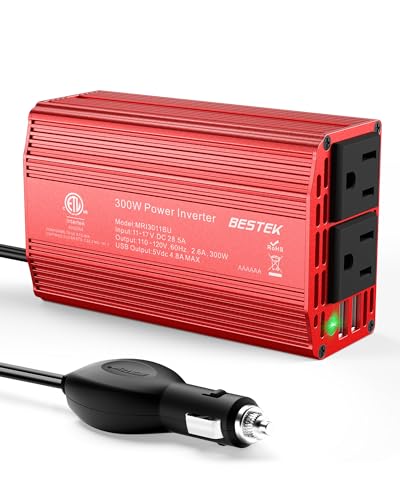
- 300W continuous and 700W instantaneous power
- Two AC outlets and dual 4.8A USB ports
- Compact aluminum body with 32-inch cable
Best For: Portable charging during vacations, commutes, work trips, and camping
Lightweight Everyday Option

- Compact design weighs about 9 ounces
- Two AC outlets and four USB-A/C ports
- Quiet cooling fan for extended use
Best For: Basic 12V vehicle charging for phones, cameras, laptops, and camping electronics
Compact Multi-Device Pick
PiSFAU 200W Car Power Inverter

- Two AC outlets plus four USB charging ports
- Compact, lightweight vehicle-socket design
- Multiple built-in safety protections
Best For: Charging several small personal devices on road trips
Higher-Power Family Travel Choice
Pro Chaser 400W Power Inverter
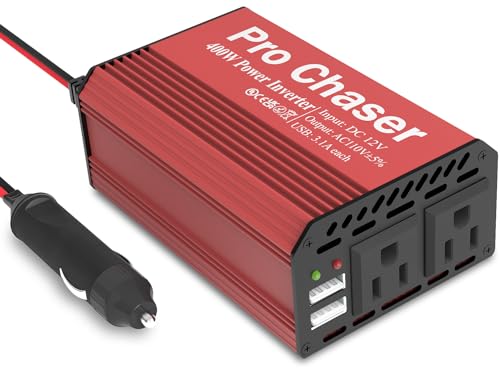
- 400W continuous and 800W peak output
- Dual AC sockets plus two 3.1A USB ports
- Includes a 30-inch cord and cooling fan
Best For: Travelers powering several devices and moderate-load electronics
Safety-Focused Compact Option
Ampeak 150W Car Power Inverter

- One AC outlet and two 2.4A USB ports
- Compact adjustable cigarette-lighter design
- Advertises 11 safety protections and a cooling fan
Best For: Light-duty charging of phones, tablets, laptops, and accessories
Best Compact Pick
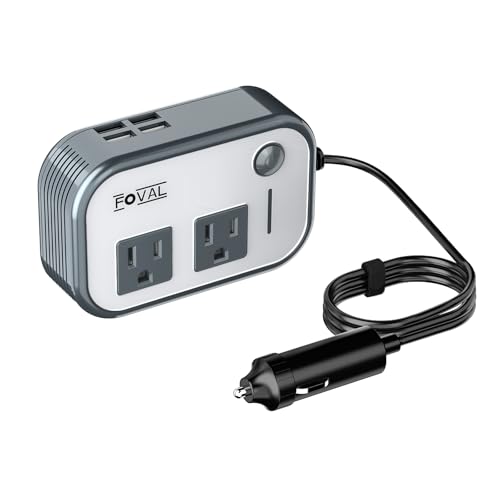
- Two AC outlets and four USB ports
- Lightweight, compact travel design
- Multiple built-in safety protections
Best For: Charging everyday electronics in 12V vehicles
Best Fast-Charging Pick
BESTEK 300W Car Power Inverter

- 30W USB-C PD and 18W USB-A QC
- 300W continuous, 700W peak output
- Compact metal housing with protection features
Best For: Fast-charging devices and powering moderate electronics
Best Higher-Power Pick
BESTEK 400W Car Power Inverter

- 400W output with two AC outlets
- 30W USB-C PD and USB-A QC charging
- ETL-certified with built-in 40A fuse
Best For: Road trips requiring more power for electronics and small essentials
High-Output Road-Trip Pick – 1000W Vehicle Inverter
For travelers who need more capacity from their car inverters for road trips, this TWING model offers 750W of continuous output and 1000W peak power. It includes dual AC outlets, QC 3.0 USB charging, and a 30W USB-C PD port for a mix of travel electronics.
Best For: Road trips, camping, emergency backup, and powering several moderate-demand devices from a 12V vehicle or battery.
Pros:
- 750W continuous and 1000W peak output.
- Two AC outlets plus QC 3.0 and 30W PD USB charging.
- Digital display and protection against overvoltage, low voltage, overload, short circuits, and overheating.
- Can connect through a cigarette lighter or directly to a 12V battery.
Cons:
- Uses a modified sine wave output.
- Higher loads may require direct battery connection rather than the cigarette-lighter adapter.
- Requires a well-ventilated, dry operating area.
This is the most capable option here for users who want multiple charging outlets and substantial power. Check the total wattage of your devices carefully, and remember not to exceed the inverter’s stated maximum.
Compact Travel Favorite – BESTEK 300W Car Inverter
The BESTEK 300W inverter is a compact choice among car inverters for road trips, with an iPhone-sized aluminum housing and a 32-inch cigarette-lighter cable. It provides two AC outlets and two 4.8A USB ports for everyday travel charging.
Best For: Vacation travel, work trips, camping, and charging phones, laptops, tablets, and cameras in compatible 11–17V vehicles.
Pros:
- 300W continuous output and 700W instantaneous power.
- Two AC outlets and two high-output 4.8A USB ports.
- Compact, lightweight aluminum housing with a long 32-inch cable.
- Includes protection for overheating, voltage issues, short circuits, and overloads.
Cons:
- Lower continuous capacity than larger 1000W-class inverters.
- Modified sine wave output may not suit every device.
- Designed for 11–17V vehicles and should not be treated as a high-power appliance inverter.
Choose this model when portability and convenient USB charging matter more than running demanding equipment. Its compact design makes it easy to keep in a vehicle without taking up much space.
Best Outlet Variety – POWERFUEL 1200W Peak Inverter
This POWERFUEL model is designed for travelers who want plenty of connection points in a single unit. As one of the more versatile car inverters for road trips, it has three AC outlets, three USB ports, and one USB-C port, along with an LCD status display.
Best For: Families, group travel, camping, RV use, truck use, and monitoring inverter status while charging several devices.
Pros:
- 1200W peak output with three AC outlets.
- Three USB ports plus one USB-C port for flexible charging.
- LCD screen displays input voltage, output voltage, and battery level.
- Six-way protection covers overvoltage, undervoltage, overload, overheating, short circuits, and reverse polarity.
Cons:
- The supplied details identify peak output but do not specify continuous wattage.
- Designed for 12V input, so vehicle compatibility should be checked before purchase.
- Output suitability for sensitive electronics is not specified in the supplied information.
The large number of outlets and real-time LCD monitoring make this a practical shared-use option. Before connecting power-hungry equipment, verify its continuous-load requirements and the vehicle or battery’s available capacity.
Lightweight Everyday Option – YSOLX 300W Car Inverter
For basic travel charging in a small package, the YSOLX 300W model offers two AC outlets and four USB-A/C charging ports. Its roughly 9-ounce design makes it an easy-to-store choice among car inverters for road trips.
Best For: Charging phones, cameras, laptops, game consoles, small electronics, and selected low-power camping devices from a 12V car outlet.
Pros:
- Lightweight, compact design measuring about 5.43 by 2.75 by 1.4 inches.
- Two AC outlets and four USB-A/C ports provide six output connections.
- Quiet intelligent cooling fan supports extended use.
- Useful for phones, cameras, laptops, lights, fans, and other listed travel electronics.
Cons:
- Not intended for high-power appliances such as hair dryers or electric heaters.
- Supplied specifications list conflicting output figures, including 300W wattage and 200W output/peak details.
- Limited to DC 12V vehicle use.
This is a convenient low-profile inverter for everyday electronics rather than heavy appliances. Because the supplied specifications include different output figures, use a conservative load and follow the included product guidance.
Compact Multi-Device Pick – PiSFAU 200W Car Power Inverter
For shoppers comparing car inverters for road trips, the PiSFAU 200W model offers a compact way to run small electronics from a vehicle’s 12V socket. It combines two AC outlets with four USB charging ports in a lightweight, phone-sized design.
Best For: Road travelers who need to charge several phones, tablets, or other small devices at once.
Pros:
- Two AC outlets and four USB ports provide six charging connections.
- Compact 5-by-2.7-by-1.4-inch design weighs about 8.8 ounces.
- Built-in protection helps guard against overheating, undervoltage, overvoltage, overload, and short circuits.
- Designed with heat dissipation technology to reduce operating noise.
Cons:
- Its 200W output is intended for lower-power electronics, not demanding appliances.
- The modified sine wave output may not suit every AC-powered device.
The PiSFAU is a practical space-saving choice when your road-trip priority is charging multiple personal devices rather than powering high-wattage equipment. Its 1-year warranty and stated 24-hour support add useful reassurance.
Higher-Power Family Travel Choice – Pro Chaser 400W Power Inverter
Among car inverters for road trips, the Pro Chaser 400W model stands out for its higher continuous output and flexible 30-inch cord. It provides dual AC outlets and dual USB ports for common travel electronics and selected 300W–400W devices.
Best For: Families and travelers who need more AC capacity for laptops, DVD players, bottle warmers, or similar equipment.
Pros:
- Supplies 400W continuously with an 800W peak output.
- Dual 110V AC sockets and two 3.1A USB ports support multiple devices.
- Thirty-inch cord makes positioning more flexible in a vehicle.
- Protection features include safeguards for overload, voltage problems, and overheating; the fan activates at 113°F.
Cons:
- Modified sine wave output may limit compatibility with some equipment.
- Requires use in a cool, dry environment according to the safety notice.
- Higher output can draw more power from the vehicle than smaller inverters.
The Pro Chaser is the stronger fit when a road-trip setup needs more AC headroom than a basic phone-and-tablet charger. Its compact body, longer cable, cooling fan, and 12-month warranty make it a flexible travel option.
Safety-Focused Compact Option – Ampeak 150W Car Power Inverter
The Ampeak 150W is a straightforward option for shoppers seeking car inverters for road trips, camping, or everyday vehicle charging. Its adjustable cigarette-lighter design includes one AC outlet and two 2.4A USB ports in a compact housing.
Best For: Drivers who mainly need to charge phones, tablets, laptops, and small accessories from a 12V vehicle outlet.
Pros:
- Provides one AC outlet and two USB ports with 4.8A total USB output.
- Compact 5.4-by-2.8-by-1.5-inch design suits cars, SUVs, trucks, and RVs.
- Advertises 11 layers of protection for vehicle electronics and connected devices.
- Includes a cooling fan and claims 88% conversion efficiency.
Cons:
- Its 150W rating offers less capacity than the other options here.
- Only one AC outlet is available.
- The modified sine wave output may not work ideally with every AC device.
The Ampeak makes sense for light-duty road-trip charging where compact size and safety features matter more than multiple AC outlets or high wattage. Its 18-month warranty and stated 30-day return period are additional buying considerations.
Best Compact Pick – FOVAL 200W Car Power Inverter
For shoppers comparing car inverters for road trips, the FOVAL 200W model is a compact option for charging several smaller devices at once. It provides two AC outlets and four USB ports from a 12V vehicle socket, with a lightweight design that is easy to store.
Best For: Travelers who need a small inverter for phones, tablets, laptops, cameras, and other lower-power electronics.
Pros:
- Offers two AC outlets and four USB charging ports.
- Compact, credit-card-sized design weighs about 8 ounces.
- Includes short-circuit, low-voltage, overcharge, overload, and overtemperature protection.
- Features a cooling fan that adjusts as the unit warms up.
Cons:
- Designed only for 12V vehicles, not 24V systems or airplanes.
- Not intended for high-power appliances such as hair dryers or heaters.
- Uses a modified sine wave output.
The FOVAL is a practical space-saving choice when portability and multiple charging connections matter more than high-wattage appliance support. Its 200W rating is best matched with everyday electronics and modest road-trip power needs.
Best Fast-Charging Pick – BESTEK 300W Car Power Inverter
Among car inverters for road trips, the BESTEK 300W model stands out for combining AC power with faster USB charging. Its USB-C port supports up to 30W PD charging, while the USB-A port supports QC 18W for compatible devices.
Best For: Road trippers who want faster phone charging alongside power for laptops, cameras, game consoles, CPAP equipment, or other modest electronics.
Pros:
- Provides 300W continuous output and up to 700W peak surge power.
- Includes 30W USB-C PD and 18W USB-A QC charging.
- Compact metal housing is designed for portability and impact resistance.
- Offers short-circuit, overload, overvoltage, and overheating protection.
Cons:
- Clamps are not included.
- Uses a modified sine wave output.
- Requires a 12V vehicle power connection.
This BESTEK model is a versatile middle-ground option for travelers who value quicker USB charging and a little more AC capacity than a basic compact inverter. It remains intended for electronics and moderate loads rather than high-power household appliances.
Best Higher-Power Pick – BESTEK 400W Car Power Inverter
For road trips that require more capacity, this BESTEK 400W inverter delivers stable 12V-to-110V power through two AC outlets, along with USB-C PD and USB-A fast-charging ports. Its compact form is designed to fit conveniently in a vehicle.
Best For: Travelers needing extra capacity for laptops, breast pumps, DVD players, bottle warmers, and multiple personal devices.
Pros:
- Supplies 400W output for compatible devices.
- Includes two 110V AC outlets, 30W USB-C PD, and USB-A QC 3.0.
- Compact design and 32-pin cigarette-lighter plug suit travel use.
- ETL-certified and equipped with a built-in 40-amp fuse.
Cons:
- Connected loads should remain within the 400W rating.
- Designed for 12V vehicle use.
- Warranty coverage is listed as 12 months.
The 400W BESTEK is the strongest fit here for travelers who want more AC headroom without moving to a larger battery-connected inverter. Its fast-charging ports and dual outlets make it useful for shared vehicle charging, provided connected devices stay within the rated output.
How We Picked These Car Inverters for Road Trips
We focused on practical factors that matter during vehicle travel: rated wattage, peak capacity, outlet and USB-port selection, portability, input compatibility, and ease of use. The lineup includes compact cigarette-lighter models for everyday charging as well as higher-output inverters intended for more demanding electronics.
Because specifications and real-world performance can vary by manufacturer and vehicle, treat the listed wattage as a planning reference rather than a guarantee that every device can run simultaneously. Always check the product documentation and your vehicle’s outlet rating before connecting high-draw equipment.
Quick Comparison
| Power range | Best suited for | Typical advantage |
|---|---|---|
| 150W–200W | Phones, tablets, cameras, small chargers | Compact and easy to carry |
| 300W–400W | Laptops, multiple chargers, small electronics | Good balance of output and portability |
| 1000W–1200W peak-class models | Several devices or higher startup loads | More headroom, often with extra outlets |
Key Buying Factors for Car Inverters for Road Trips
Continuous and Peak Wattage
Continuous wattage indicates what an inverter can generally support over time, while peak or surge wattage covers short startup demands. Add the wattage of the devices you expect to use and leave some headroom. A higher number is not automatically better if your vehicle’s 12V socket cannot safely supply the required current.
Ports and Outlet Layout
Count the devices you normally charge. Multiple AC outlets are useful for laptop bricks and camera chargers, while USB-A and USB-C ports reduce the need for bulky wall adapters. If fast charging matters, verify the USB-C output specification rather than assuming every Type-C port supports the same speed or power delivery.
Vehicle Compatibility and Safety
Most products here are designed for 12V vehicle systems and plug into a cigarette-lighter-style outlet. Check the socket’s fuse rating, avoid exceeding the inverter’s limits, and never leave high-draw equipment running unattended. Built-in overheat, overload, short-circuit, and low-voltage protection are valuable features, but they do not replace careful load management.
Size, Cooling, and Convenience
Compact adapters are easier to store and suit short charging sessions. Larger units may provide more outlets and wattage but require better ventilation and can occupy more cabin space. Look for accessible controls, clear indicator lights, sturdy cables, and a fan design that will not be constantly obstructed.
Who Should Buy Which Car Inverters for Road Trips?
Choose a 150W–200W Model If:
You mainly need to charge phones, tablets, cameras, handheld game systems, or other small electronics. These models are usually the simplest choice for passengers and minimalist road-trip kits.
Choose a 300W–400W Model If:
You want to run a laptop charger alongside several smaller devices or need a versatile all-purpose travel inverter. This range offers a useful middle ground for most family and work trips.
Choose a Higher-Output Model If:
You need several AC outlets, expect short startup surges, or want more capacity for a larger group of devices. Confirm that the vehicle’s electrical system and outlet can support the intended load; otherwise, a lower-wattage model may be safer and more practical.