The right trailer brake controller helps your tow vehicle and trailer slow down together, improving control during routine stops, steep descents, and emergency braking. The best choice depends on your trailer’s axle count, wiring, vehicle compatibility, and preferred installation style.
Our roundup includes proportional, time-delay, plug-and-play, and Bluetooth options for different towing setups and budgets. Use the guide below to narrow the field before choosing a controller.
Best 10 Trailer Brake Controllers Picks for 2026
Best Integrated Control

- Proportional braking for smoother stops
- Compact dash-mounted remote dial
- Supports 1- to 2-axle trailers
Best For: SUV and truck owners wanting discreet, everyday towing control
Best Portable Option
CURT Echo Bluetooth Controller

- Transfers between compatible vehicles
- No under-dash wiring when circuits are present
- App-controlled proportional braking
Best For: Multi-vehicle owners wanting a portable 7-way solution
Best Wide-Capacity Value
Lrichy Proportional Brake Controller
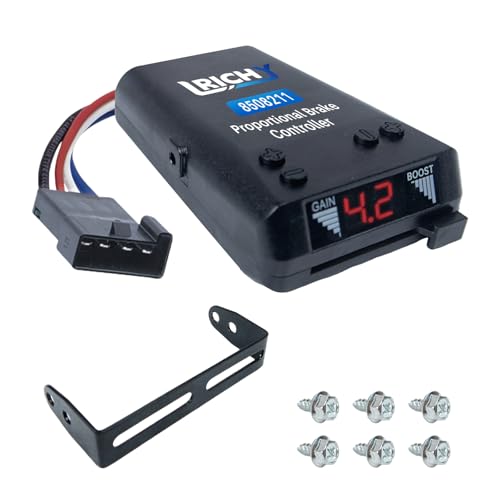
- Handles 1- to 4-axle trailers
- LED display includes diagnostics and alarms
- Includes brackets, screws, and two-year warranty
Best For: Owners needing proportional control across several trailer sizes
Best Low-Profile Adjustability

- Slim housing improves dash clearance
- Triple-axis sensing for responsive stops
- Works with 1- to 4-axle trailers
Best For: Drivers towing varied trailer sizes or hilly routes
Best Budget Time-Delay Pick

- Time-delay control for 1–4 axles
- LED settings and fault display
- Overcurrent and short-circuit protection
Best For: Light-duty and occasional towing
Best Proportional Control

- Automatically mirrors tow-vehicle braking
- Supports 1–4 axles and 2–8 brakes
- Digital LED voltage display
Best For: Responsive braking across varied towing conditions
Best Low-Profile Plug-and-Play Option

- Slim design with improved dash clearance
- Adjustable power and ramp time
- Handles 1–3 axles without leveling
Best For: Compact installations on smaller trailer setups
Best Proportional Pick
briidea Proportional Brake Controller

- Proportional braking uses motion sensors
- Boost mode adjusts force for heavier loads
- Supports 1-4 braked axles
Best For: Frequent and heavy-duty towing
Best Feature-Rich Alternative
Lrichy 90885 Proportional Controller
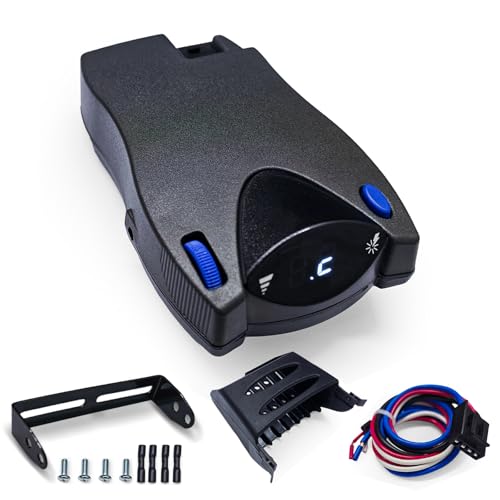
- Proportional braking works in reverse
- Includes diagnostics, boost, and manual override
- Supports up to 8 electric trailer brakes
Best For: Feature-focused towing setups
Best Low-Profile Time-Delay Pick
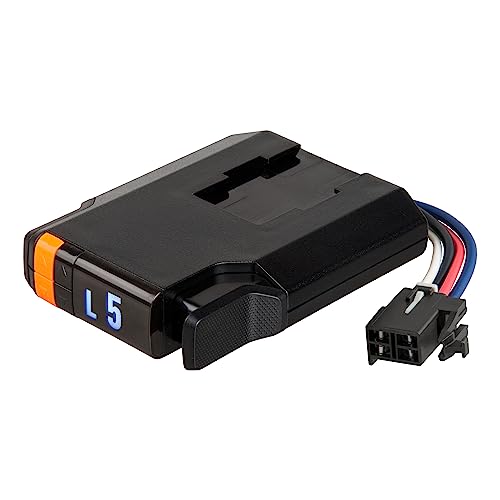
- Slim design improves dashboard clearance
- Adjustable power and ramp time
- Handles up to 8 trailer brakes
Best For: Compact, straightforward towing setups
Best Integrated Control – REDARC Tow-Pro Liberty
For drivers who want discreet, smooth control, the REDARC Tow-Pro Liberty is one of the more compact trailer brake controllers to consider. Its proportional braking, active calibration, and dash-mounted remote dial are designed for everyday towing with trailers using one or two axles.
Best For: SUV and truck owners seeking a low-profile, proportional controller for common 1- to 2-axle towing applications.
Pros:
- Proportional braking helps reduce push and pull during on-road stops.
- Compact remote dial blends into the vehicle dashboard.
- Supports most common 1- to 2-axle trailer braking applications.
- Includes a two-year limited warranty and is designed for demanding towing conditions.
Cons:
- Vehicle-specific or universal wiring harnesses are sold separately.
- It is not a complete plug-and-play wiring kit out of the box.
The Tow-Pro Liberty is a strong fit when smooth braking and a clean installation matter more than having a built-in display. Confirm harness compatibility for your vehicle before ordering.
Best Portable Option – CURT Echo Bluetooth Controller
The CURT Echo takes a different approach to trailer brake controllers by plugging into a compatible vehicle and trailer 7-way connection. It transfers between vehicles without under-dash wiring and uses the OneControl Auto app for setup and adjustments.
Best For: Towing households that use multiple compatible vehicles and prefer a portable, smartphone-managed controller.
Pros:
- Installs between 7-way connectors without under-dash wiring or tools when the required vehicle circuits are present.
- Transfers easily between compatible tow vehicles.
- Triple-axis sensing provides proportional braking for 1- to 2-axle trailers.
- Continues using the latest programmed settings if Bluetooth communication is lost.
Cons:
- Requires a compatible 7-way with active power, ground, and turn-signal circuits.
- App control and notifications require Bluetooth communication and the OneControl Auto app.
- The app should remain in the foreground for prompt manual-override response.
Echo is especially convenient for shared vehicles or occasional towing, but its app-based operation adds setup requirements. Verify 7-way power and circuit compatibility before relying on it.
Best Wide-Capacity Value – Lrichy Proportional Brake Controller
The Lrichy N8508211 is a proportional controller designed for a broad range of trailer sizes. Its internal sensors adjust braking according to tow-vehicle braking intensity and speed, while the display provides settings, diagnostics, and alarm information.
Best For: Owners towing trailers with two to eight brakes who want proportional operation and a visible diagnostic display.
Pros:
- Supports 1- to 4-axle trailers with 2, 4, 6, or 8 brakes.
- Proportional sensing adjusts braking to the tow vehicle’s braking intensity and speed.
- LED display shows settings, diagnostics, and alarms.
- Includes mounting hardware and a two-year warranty.
Cons:
- Vehicle-specific plug-and-play wiring harness is not included.
- Compatibility and installation should be confirmed for the specific tow vehicle.
This controller stands out for its wide brake-capacity range and straightforward display. It may suit owners upgrading from time-delay control, provided they source the appropriate harness separately.
Best Low-Profile Adjustability – CURT TriFlex NEXT
The CURT TriFlex NEXT combines a slim housing with adjustable proportional control for trailers ranging from two to eight brakes. Its triple-axis accelerometer responds to vehicle motion and can adjust power dynamically when towing uphill or downhill.
Best For: Drivers who want a low-profile, adjustable controller for 1- to 4-axle trailers and varied terrain.
Pros:
- Low-profile design helps preserve dash clearance.
- Triple-axis sensing supports smooth, responsive stops.
- Dynamic power adjustments account for uphill and downhill towing.
- Operates up to eight trailer brakes across 1- to 4-axle setups.
Cons:
- The supplied notes do not specify included vehicle wiring components.
- Installation compatibility should be checked before purchase.
TriFlex NEXT is a practical choice for buyers prioritizing compact fit and adaptable proportional braking. Its broad axle coverage also leaves room for towing setups that may grow beyond a single-axle trailer.
Best Budget Time-Delay Pick – Briidea BR-121
The Briidea BR-121 is a practical choice among trailer brake controllers for light-duty and occasional towing. Its time-delay operation, LED readout, and built-in fault protections provide adjustable braking control without an overly complicated setup.
Best For: Light-duty and occasional towing with trailers using 1 to 4 braked axles.
Pros:
- Supports 1 to 4 braked axles, or 2 to 8 brakes.
- LED display shows gain settings, output voltage, and fault information.
- Includes overcurrent, short-circuit, and fault detection protections.
- Mounting bracket and accessories support flexible installation under the dashboard.
Cons:
- Time-delay braking requires the power and timing settings to be adjusted for conditions.
- The supplied notes position it primarily for light-duty and occasional towing.
Choose the Briidea if you want broad trailer compatibility and straightforward monitoring at a practical price. Drivers seeking braking that automatically mirrors tow-vehicle deceleration may prefer a proportional controller instead.
Best Proportional Control – Timilge BC06
The Timilge BC06 stands out among trailer brake controllers for its proportional braking system. It senses how quickly the tow vehicle slows and applies corresponding trailer braking, while its digital display helps you monitor voltage and adjust the controls.
Best For: Towing drivers who want responsive proportional braking for trailers with 1 to 4 axles.
Pros:
- Automatically matches trailer braking intensity to tow-vehicle deceleration.
- Supports 1 to 4 axles, or 2 to 8 brakes.
- Digital LED display shows voltage delivered to the trailer brakes.
- Requires no leveling and supports vehicle-specific wiring harness connections.
Cons:
- The controller must be powered down or disconnected when the truck is shut off or unused for long periods.
- Installation requires correct four-wire connections for power, stop light, ground, and trailer brakes.
The BC06 is a strong fit when smooth, automatically matched braking matters more than the simplicity of a time-delay unit. Its adjustable braking power and synchronization also allow fine-tuning for trailer and road conditions.
Best Low-Profile Plug-and-Play Option – CURT Venturer NEXT
The CURT Venturer NEXT is a compact time-delay option for shoppers comparing trailer brake controllers with a discreet installation. Its slim design, improved dash clearance, and adjustable power and ramp time make it suitable for controlled braking across smaller trailer setups.
Best For: Drivers wanting a low-profile, adjustable controller for trailers with 1 to 3 axles.
Pros:
- Slim, low-profile design helps preserve dashboard space.
- Unique bracket system is designed for improved dash clearance.
- Power and ramp time are fully adjustable.
- Operates 2 to 6 trailer brakes and uses a plug-and-play installation approach.
Cons:
- Supports up to 3 axles, fewer than the 4-axle capacity of some alternatives.
- Its time-delay system does not automatically match braking intensity like a proportional controller.
The Venturer NEXT makes the most sense when a clean, space-conscious installation is a priority. It combines adjustable time-delay performance with a simple design and no leveling requirement, though larger four-axle applications will need another controller.
Best Proportional Pick – briidea Proportional Brake Controller
For drivers comparing trailer brake controllers, the briidea BR-122 is a proportional option designed to match trailer braking to the tow vehicle’s deceleration. Its boost mode, digital display, and support for up to four axles make it a practical choice for heavier or frequent towing.
Best For: Heavy-duty towing, travel trailers, cargo trailers, boat trailers, and users who want proportional braking with visible settings.
Pros:
- Motion sensors adjust trailer braking to the tow vehicle’s deceleration.
- Boost mode helps fine-tune braking for different vehicle and trailer weight distributions.
- Supports 1-4 braked axles and includes overcurrent, short-circuit, and fault protection.
- LED display shows settings, output voltage, and boost levels.
Cons:
- The controller should be mounted under the dashboard to avoid obstructing the driver’s view.
- The supplied notes do not specify a vehicle-specific plug-and-play harness.
The briidea stands out for combining proportional control, adjustable boost, and broad axle coverage in a compact kit. It is especially appealing when smooth braking and frequent trailer use matter more than the simplest installation.
Best Feature-Rich Alternative – Lrichy 90885 Proportional Controller
The Lrichy 90885 is a proportional trailer brake controller with diagnostics, boost adjustment, and reverse operation. It is positioned as a replacement for the Tekonsha 90885 Prodigy P2 and supports electric-brake trailers with up to four axles.
Best For: Towing setups that benefit from continuous diagnostics, reverse proportional braking, flexible mounting, and a removable connection.
Pros:
- Applies trailer braking in proportion to the tow vehicle’s deceleration.
- Works proportionally in reverse and can be disabled when needed.
- Provides manual override, multi-level boost, system diagnostics, and a bright LED display.
- Supports 2, 4, 6, or 8 electric trailer brakes and includes a two-year warranty.
Cons:
- A vehicle-specific plug-and-play harness is not included.
- Its listed weight and package size are greater than the compact briidea unit.
With its diagnostic monitoring, reverse functionality, and storage-friendly removable connector, the Lrichy offers a broad feature set. Confirm harness requirements before buying, particularly if you expect a plug-and-play installation.
Best Low-Profile Time-Delay Pick – CURT Discovery NEXT 51126
The CURT Discovery NEXT 51126 takes a simpler time-delay approach to trailer brake controllers. Its low-profile housing, adjustable power and ramp time, and plug-and-play design make it a practical option for drivers who want flexible brake settings without a proportional sensor system.
Best For: Towing setups using 2-4 axles where compact dashboard fit, adjustable braking, and straightforward installation are priorities.
Pros:
- Slim, low-profile design helps preserve dashboard clearance.
- Power and ramp time are fully adjustable.
- Operates up to eight trailer brakes across one to four axles.
- Requires no leveling and has no internal moving parts.
Cons:
- Time-delay braking does not automatically match braking force to vehicle deceleration like a proportional controller.
- The supplied notes provide fewer diagnostic and display details than the other listed controllers.
The CURT is a sensible choice when a compact footprint and adjustable time-delay operation are more important than proportional braking. Its plug-and-play format and limited-lifetime manufacturer warranty add practical appeal for compatible installations.
How We Picked the Best Trailer Brake Controllers
We focused on controllers that cover common towing needs, from compact one- and two-axle utility trailers to larger four-axle setups. We considered braking technology, adjustment range, installation method, compatibility, display or diagnostic features, and the controller’s ability to provide predictable braking input.
Proportional models generally offer the most natural response because they match trailer braking to the tow vehicle’s deceleration. Time-delay models can be simpler and more affordable, while Bluetooth units may suit drivers who want a removable, low-profile control interface.
Quick Comparison
- Best for smooth braking: Proportional controllers such as the REDARC, CURT TriFlex Next, and compatible proportional alternatives.
- Best for a clean dashboard: The CURT Echo Mobile Bluetooth controller, provided your vehicle has a compatible 7-way connection and smartphone support.
- Best for plug-and-play installation: CURT’s Next-series models, when matched with the correct vehicle-specific harness.
- Best for broad axle coverage: Controllers rated for one to four axles, including several proportional and time-delay options in this roundup.
- Best for value-focused setups: Adjustable time-delay models can provide reliable control without the added cost or calibration needs of some proportional systems.
Key Buying Factors for Trailer Brake Controllers
Braking Type
Proportional controllers sense tow-vehicle braking and apply the trailer brakes in proportion, helping reduce push and improve smoothness. Time-delay controllers apply a preset level after a short delay; they are often easier to configure but may need more adjustment for different loads and road conditions.
Axle and Brake Capacity
Verify that the controller supports your trailer’s number of axles and electric brakes. A controller rated for one to four axles offers flexibility, but capacity alone does not replace checking the manufacturer’s wiring and vehicle requirements.
Installation and Controls
Traditional dash-mounted units require accessible wiring and a suitable mounting position. Plug-and-play systems simplify installation when the correct adapter is available. Bluetooth models can reduce dashboard clutter, but they depend on a compatible mobile device and a secure 7-way connection.
Adjustment and Safety Features
Look for accessible gain and boost controls, a readable display or status indicator, manual override access, and alerts for overloads or wiring faults. These features make it easier to tune braking for trailer weight, road conditions, and changing cargo.
Who Should Buy Which Trailer Brake Controllers?
Choose a proportional controller if you tow frequently, carry varying loads, or prioritize smooth braking and reduced trailer push. Choose a time-delay model if you want straightforward operation at a lower cost and are comfortable tuning the output manually.
Choose a Bluetooth controller if you prefer a removable setup and have a compatible 7-way vehicle connection. Choose a plug-and-play controller if your tow vehicle supports the required harness and you want to avoid extensive wiring. Before buying, confirm vehicle compatibility, trailer brake wiring, axle count, and local towing requirements.