A reliable battery tester can help you spot a weak battery before it leaves you stranded. The best conductance car battery testers provide quick readings for battery condition, cranking capability, and alternator performance without requiring a traditional load test.
We compared 10 options for cars, trucks, motorcycles, boats, and other vehicles, focusing on voltage compatibility, CCA ranges, battery-type support, display readability, and useful diagnostic features.
Best 10 Conductance Car Battery Testers Picks for 2026
Professional Shop Choice

- Tests 12V and 24V lead-acid batteries
- Prints battery and system test reports
- Large color screen with data playback
Best For: Auto shops and battery dealers needing versatile, documented testing
Reliable 12V Value

- Reports SOH, SOC, CCA, and voltage
- Supports common 12V lead-acid battery types
- Includes four built-in safety protections
Best For: Everyday 12V testing across conventional vehicles and equipment
Fast Printed Diagnostics

- Produces results in about three seconds
- Includes a built-in thermal printer
- Tests 12V batteries and 12V/24V vehicle systems
Best For: Fast checks and printed reports for automotive service work
Multilingual Conductance Tester

- Supports several battery rating standards
- Includes multilingual operation and printing
- Tests common 12V lead-acid battery types
Best For: Basic 12V testing with multilingual controls and printed results
Best Overall
FOXWELL BT705 Professional Battery Tester
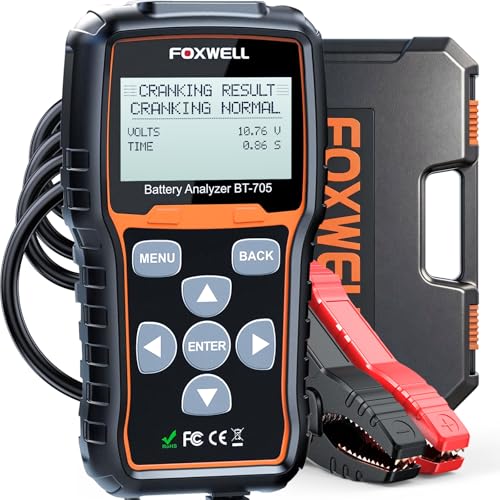
- Tests 12V and 24V systems from 100–2000 CCA
- Checks battery, cranking, and charging performance
- Long cable and carrying case support one-person testing
Best For: Multi-vehicle owners, garages, and fleet maintenance
Best Simple 12V Option
MOTOPOWER MP0515A Battery Tester

- Designed for 12V car batteries
- Tests 100–2000 CCA, cranking, and charging
- Compact design includes a storage bag
Best For: Routine checks on standard 12V vehicles
Best for Low-Charge Testing
Tech Professional B300 Conductance Analyzer

- Tests 12V batteries down to 5% state of charge
- Shows capacity percentage and battery condition
- Checks starter, alternator, and voltage performance
Best For: Clear 12V testing across automotive and deep-cycle applications
Best All-Around Pick

- Tests 12V/24V batteries from 100–2000 CCA
- Checks battery, cranking, and charging systems
- Color display with broad vehicle compatibility
Best For: DIYers and garages needing a versatile multi-vehicle tester
Best for Simple, Durable Testing
AstroAI 12V/24V Battery Tester

- Reports CCA, SOH, SOC, and internal resistance
- Supports FLA, AGM, GEL, and EFB batteries
- Adds reverse-polarity and over-voltage protection
Best For: Users wanting guided, repeatable diagnostics for conventional vehicle batteries
Best for Broad Battery Coverage
AUTOPHIX BAS100 Battery Tester

- Tests 12V/24V batteries across 100–2000 CCA
- Supports multiple battery types and standards
- Adds health, cranking, charging, and safety checks
Best For: Mixed-fleet maintenance and users needing broad compatibility
Professional Shop Choice – TOPDON BT600
For technicians comparing conductance car battery testers, the TOPDON BT600 stands out with broad battery coverage, cranking and charging-system tests, and a large color display. It supports 12V and 24V lead-acid batteries from 100 to 2000 CCA and can print test reports immediately.
Best For: Auto shops, battery dealers, and users who need documented battery and system test results.
Pros:
- Tests 12V and 24V lead-acid batteries across several battery types.
- Handles battery health, cranking, and charging-system tests.
- Includes a 3.5-inch color screen, built-in thermal printer, and data playback.
- Supports software optimization through a mini-USB port on Windows systems.
Cons:
- Its professional features and 1.29 kg weight may be more than casual users need.
- Software optimization is limited to Windows systems.
The BT600 is a strong choice when testing versatility and printable records matter more than compact simplicity. Its wide CCA range and 24V support make it especially suitable for mixed vehicle work.
Reliable 12V Value – ANCEL BA101
The ANCEL BA101 is a practical option among conductance car battery testers for checking common 12V automotive batteries. It reports state of health, state of charge, voltage, current, and CCA, while also testing cranking and charging systems.
Best For: Vehicle owners and technicians testing 12V lead-acid batteries in cars, trucks, boats, RVs, and powersports equipment.
Pros:
- Supports 100–2000 CCA batteries and multiple rating standards.
- Works with flooded, AGM, GEL, and EFB 12V batteries over 30Ah.
- Includes reverse-polarity, short-circuit, overcurrent, and overvoltage protection.
- Draws power directly from the vehicle battery, so it has no internal battery to charge.
Cons:
- Does not support lithium, 6V, 8V, or 24V batteries.
- Not intended for motorcycles below 30Ah.
- Uses a basic black-and-white display rather than a color screen.
The BA101 focuses on straightforward 12V diagnostics and safety protections. It is a sensible pick for broad conventional lead-acid compatibility, provided your battery falls within its voltage and capacity limits.
Fast Printed Diagnostics – TOPDON BT300P
For shoppers seeking conductance car battery testers with quick results and paper records, the TOPDON BT300P is built for practical automotive diagnostics. It tests 12V batteries and 12V/24V cranking and charging systems, with results reportedly available in about three seconds.
Best For: DIY users and service professionals who want fast testing, printed receipts, and support for a wide range of vehicles.
Pros:
- Tests 100–2000 CCA 12V batteries, including flooded, AGM, GEL, and EFB types.
- Checks battery condition plus 12V/24V cranking and charging systems.
- Built-in thermal printer requires only standard thermal paper.
- Provides reverse-polarity protection, insulated housing, and a 31.5-inch cable.
Cons:
- Battery testing is specified for 12V batteries, not 24V batteries.
- The 2.4-inch display is smaller than the BT600’s screen.
- Thermal paper must be replenished for printed reports.
The BT300P balances speed, vehicle coverage, and report printing in a compact diagnostic tool. Choose it when you want a printer and 24V system testing without needing a tester designed for 24V batteries.
Multilingual Conductance Tester – Keenso 12V Battery Tester
The Keenso 12V Battery Tester is a straightforward choice among conductance car battery testers for checking 12V cranking batteries and vehicle systems. Its conductance technology evaluates battery condition and cold-cranking capability, while the built-in printer creates a physical record of the test.
Best For: Users needing multilingual operation, printed results, and testing for common 12V automotive lead-acid batteries.
Pros:
- Tests flooded, AGM flat-plate, AGM spiral, and GEL batteries.
- Can test a battery with loss of charge without fully charging it first.
- Supports multiple languages and CCA, JIS, DIN, IEC, EN, SAE, and GB standards.
- Includes reverse-polarity protection to help prevent connection damage.
Cons:
- Its battery-testing scope is centered on 12V batteries.
- The supplied notes do not specify a CCA test range or warranty.
- It provides fewer stated features than the larger professional TOPDON models.
The Keenso is appealing for basic conductance testing with multilingual menus and printed diagnostics. It is best suited to users who value broad rating-system support and simple 12V battery analysis.
Best Overall – FOXWELL BT705 Professional Battery Tester
The FOXWELL BT705 is a versatile choice among conductance car battery testers for checking 12V and 24V vehicles. It measures battery condition, cranking performance, and charging output, while its guided display and long cable make routine testing easier for one person.
Best For: Home garages, repair shops, fleets, and owners of cars, trucks, RVs, boats, or other 12V/24V vehicles.
Pros:
- Tests 100–2000 CCA batteries and supports flooded, AGM, GEL, and EFB lead-acid types.
- Checks battery health, cranking performance, alternator output, and charging systems.
- Includes a 5.9-foot cable, 2.8-inch screen, protective housing, and hard carrying case.
- Provides clear GOOD, RECHARGE, or REPLACE summaries for easier interpretation.
Cons:
- Its 12V/24V capability may be more than needed for owners testing only standard car batteries.
- The corded-electric design requires connection to the vehicle battery during use.
Choose the BT705 if you want a broad, professional-style tester with practical features for repeated battery and charging-system checks across multiple vehicle types.
Best Simple 12V Option – MOTOPOWER MP0515A Battery Tester
The MOTOPOWER MP0515A is a compact option for shoppers seeking straightforward conductance car battery testers for standard 12V automotive batteries. It combines battery load testing with cranking and charging-system checks in a small, portable format.
Best For: Car owners who want a basic 12V battery tester for routine automotive checks.
Pros:
- Supports 12V car batteries with a 100–2000 CCA testing range.
- Tests battery load, engine cranking, and charging-system performance.
- Compact 340-gram design is easy to store and carry.
- Includes a storage bag and carries a two-year manufacturer warranty.
Cons:
- Designed for 12V car batteries rather than 24V systems or a wide range of vehicle applications.
- The supplied notes do not list compatibility with AGM, GEL, or EFB battery types.
The MP0515A makes sense when you need essential 12V automotive testing without the broader vehicle coverage or extra accessories of a more advanced model.
Best for Low-Charge Testing – Tech Professional B300 Conductance Analyzer
The Tech Professional B300 is a focused 12V conductance car battery tester that emphasizes simple operation and battery-capacity feedback. It can test batteries at as little as 5% state of charge, while also checking starter draw, alternator output, and voltage performance.
Best For: Automotive, motorcycle, marine, golf cart, and deep-cycle battery owners who need clear 12V health readings.
Pros:
- Tests batteries with as little as 5% state of charge using conductance technology.
- Displays battery condition as a percentage of capacity, along with health, life, and charge status.
- Checks starter, alternator, and voltage performance in voltmeter mode.
- Uses a multicolored LED bar graph and includes reverse-polarity protection.
Cons:
- Limited to 12V battery systems.
- Uses a 9V battery as its power source, which requires keeping a suitable battery available.
- Its included components list only the tester unit, with no storage case noted.
The B300 is a practical pick when low-charge testing and easy-to-read capacity feedback matter more than 24V compatibility or a large accessory bundle.
Best All-Around Pick – TOPDON BT200 Battery Tester
For shoppers comparing conductance car battery testers, the TOPDON BT200 stands out as a versatile 12V/24V diagnostic tool. It checks battery health, cranking performance, and charging-system operation across a broad 100–2000 CCA range, with support for flooded, AGM, GEL, and deep-cycle batteries.
Best For: DIYers, home garages, and vehicle owners who want one tester for cars, trucks, RVs, boats, motorcycles, and other equipment.
Pros:
- Tests 12V and 24V batteries from 100–2000 CCA.
- Performs battery, cranking, and charging-system tests.
- Supports multiple battery types and international testing standards.
- Uses a sunlight-readable color display and includes memory recall.
Cons:
- Not intended for 6V, 8V, or lithium batteries based on the listed compatibility.
- Its wide range of functions may be more than needed for simple voltage checks.
The BT200 is a strong choice when you need more than a basic battery reading. Its 24V capability, vehicle coverage, rugged construction, and stated 1-year warranty with lifetime technical support make it suitable for both occasional maintenance and regular diagnostics.
Best for Simple, Durable Testing – AstroAI 12V/24V Battery Tester
The AstroAI is a practical option among conductance car battery testers, combining battery-health measurements with alternator and charging-system analysis. Its interface is designed to guide users through testing, while the compact housing and protective features suit frequent garage or roadside use.
Best For: Car, truck, and RV owners who want straightforward readings for SOH, SOC, internal resistance, and CCA.
Pros:
- Measures CCA, state of health, state of charge, and internal resistance.
- Supports 12V/24V FLA, AGM, GEL, and EFB batteries.
- Includes reverse-polarity and over-voltage protection.
- Minimalist circuit design is intended to reduce failure points and signal drift.
Cons:
- Not compatible with lithium-ion, 6V, or 8V batteries.
- The supplied details do not list a memory function or a color display.
This model makes sense for buyers who value clear operation and basic diagnostic coverage over extra features. Its heavy-duty clamps, reinforced housing, and built-in safeguards add confidence for repeated testing across conventional 12V and 24V vehicle batteries.
Best for Broad Battery Coverage – AUTOPHIX BAS100 Battery Tester
The AUTOPHIX BAS100 is a full-featured choice for shoppers comparing conductance car battery testers. It evaluates battery health and charge, performs cranking and charging tests, and supports 12V/24V batteries across several battery designs and testing standards.
Best For: Mechanics, technicians, and DIY users maintaining mixed fleets that include cars, heavy-duty vehicles, recreational vehicles, marine equipment, and powersports equipment.
Pros:
- Tests 12V/24V batteries from 100–2000 CCA.
- Supports flooded, AGM flat-plate, AGM spiral, GEL, and EFB batteries.
- Measures SOH and SOC and adds cranking and charging tests.
- Offers reverse-connection, short-circuit, over-voltage, over-current, and temperature protection.
Cons:
- Not compatible with 6V, 8V, or lithium batteries.
- Users must select the correct battery type, standard, CCA, AH, and temperature settings for testing.
The BAS100 is particularly appealing when compatibility and safety features matter. Its handheld format and ability to test batteries whether installed or removed make it a convenient maintenance tool, while the broad vehicle and standard support helps it fit varied equipment collections.
How We Picked These Conductance Car Battery Testers
We selected testers designed for practical automotive diagnostics rather than voltage checks alone. Our comparison considered support for 12V and 24V systems, stated testing ranges up to 2,000 CCA, battery and alternator testing, cranking analysis, and compatibility with common battery types such as flooded lead-acid, AGM, gel, and EFB.
We also considered usability features that matter in a garage or service setting, including screen size, menu clarity, cable quality, portability, printer availability, and whether the tester can produce results quickly without removing the battery from the vehicle.
Quick Comparison
For basic 12V vehicle maintenance, a compact tester such as the ANCEL BA101, MOTOPOWER MP0515A, or TOPDON BT200 may provide the functions most owners need. Buyers working with trucks, commercial equipment, or mixed 12V and 24V fleets should prioritize models such as the TOPDON BT600, TOPDON BT300P, FOXWELL BT705, or comparable dual-voltage units.
Built-in printers are useful when you need a physical test record for a workshop, fleet, or used-vehicle inspection. If portability and occasional home use matter more, a printer-free model is generally simpler and easier to store. Always verify the tester’s supported battery chemistry and testing range before purchase.
Key Buying Factors for Conductance Car Battery Testers
Voltage and Vehicle Compatibility
Confirm whether you need 12V testing only or support for both 12V and 24V systems. A dual-voltage tester offers more flexibility for trucks and commercial vehicles, but it may cost more than a dedicated 12V model.
CCA Range and Battery Standards
Choose a tester whose cold-cranking amp range covers your batteries. Enter the correct CCA rating and testing standard shown on the battery label for the most meaningful result. Conductance readings are only as useful as the information entered.
Battery Chemistry Support
Flooded lead-acid, AGM, gel, and EFB batteries can use different testing settings. If you maintain newer vehicles with stop-start systems, look for explicit EFB or AGM support rather than assuming every analyzer handles them identically.
Diagnostic Functions
Battery health, cranking voltage, charging voltage, and alternator tests provide a more complete picture than a simple voltage reading. A clear pass, warning, or replace result is helpful, but the displayed voltage and measured values are also worth reviewing.
Display, Cables, and Records
Look for a readable screen, durable clamps, straightforward menus, and sufficient cable length. A built-in printer can be valuable for documentation, while a compact design may be preferable for emergency kits and occasional personal use.
Who Should Buy Which Conductance Car Battery Testers?
For home garages: Choose a straightforward 12V or dual-voltage tester with battery, cranking, and alternator checks. Ease of use is usually more important than advanced reporting.
For mechanics and service shops: A larger display, broad CCA range, multiple battery-type settings, and printed test results can speed up inspections and make customer explanations easier.
For fleet and commercial vehicles: Prioritize 12V/24V compatibility, rugged cables, repeatable readings, and documentation features. Confirm that the model supports the battery sizes and chemistries used across your fleet.
For motorcycles, boats, and powersports: Select a compact unit that supports the vehicle’s battery type and has clamps suitable for smaller terminals. Check the minimum testing requirements before relying on a full-size automotive analyzer.
Whichever model you choose, test with the battery connected correctly, use the battery’s labeled rating and chemistry, and interpret results alongside the vehicle’s age, starting behavior, and charging-system voltage.