When a battery problem needs more than a quick voltage reading, a tester with a built-in printer can document battery health, starting performance, and alternator output in seconds. Printed results are especially useful for repair shops, inspections, fleet records, and customer handoffs.
We’ve compared 10 car battery testers with printers across voltage support, CCA ranges, supported battery types, display design, and diagnostic functions to help you choose the right tool for your vehicle or workshop.
Best 10 Car Battery Testers with Printer Picks for 2026
Professional Shop Pick

- 12V/24V testing from 100–2,000 CCA
- 3.5-inch color screen with thermal printer
- Checks battery, cranking, and charging systems
Best For: Shops and technicians needing broad battery coverage and printed records
Complete Portable Kit
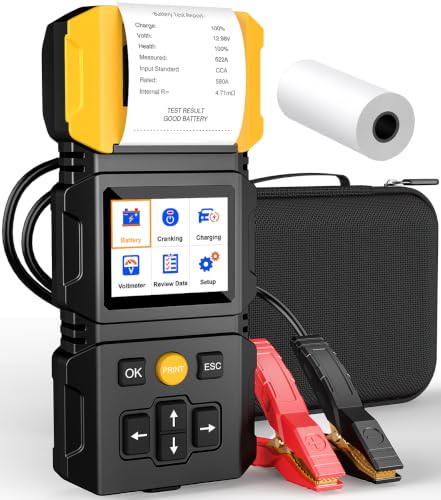
- 12V testing from 100–2,000 CCA
- One-click thermal report printing
- Includes case, USB-C cable, and two paper rolls
Best For: DIYers and mobile technicians wanting a ready-to-use kit
Advanced Diagnostic Choice

- Supports 6V/12V/24V batteries
- Prints reports and measures internal resistance
- Includes real-time waveform monitoring
Best For: Users seeking detailed lead-acid diagnostics beyond basic voltage testing
Fast 12V Testing Value

- Tests 12V/24V lead-acid batteries
- Prints diagnostic receipts with thermal paper
- Checks battery, cranking, and charging systems
Best For: Routine testing by vehicle owners and small garages
Best All-Around Lead-Acid Coverage

- Tests battery, cranking, and charging systems
- Supports 12V/24V lead-acid batteries
- Prints detailed customer-ready reports
Best For: Shops, fleets, and vehicle owners needing documented lead-acid battery tests
Best for Connected Reporting

- Tests 12V/24V batteries and charging systems
- Prints customized reports in about three seconds
- Shares results by QR code without an app
Best For: Professional service teams managing customer and fleet records
Best for Multi-Voltage Diagnostics
Universal 6V/12V/24V Battery Tester

- Supports 6V, 12V, and 24V lead-acid batteries
- Prints detailed dated test reports
- Adds load and waveform testing with 800-record storage
Best For: Multi-vehicle users needing deeper diagnostics and printed proof
Best All-Around Value

- Prints battery reports without an app or cartridges
- Tests 12V/24V batteries, cranking, and charging
- Includes safety protection and thermal paper
Best For: DIY users and general workshop battery checks
Best for Broad Compatibility

- Works with 6V, 12V, and 24V systems
- Supports lead-acid and lithium batteries
- Includes anti-jam printing and three paper rolls
Best For: Mixed-vehicle garages and varied battery types
Best for Workshop Recordkeeping

- Provides 4-in-1 battery and system diagnostics
- Stores test history and prints reports with one click
- Offers a 30–2000 CCA range and 3.2-inch color screen
Best For: Technicians managing service records and customer reports
Professional Shop Pick – TOPDON BT600
For shops needing car battery testers with printer functionality, the TOPDON BT600 combines 12V and 24V testing, a relatively large 3.5-inch color screen, and immediate thermal report printing. It covers batteries from 100 to 2,000 CCA and also checks cranking and charging systems.
Best For: Auto shops, battery dealers, and technicians working across cars, trucks, boats, and other 12V or 24V applications.
Pros:
- Tests 12V and 24V lead-acid batteries from 100 to 2,000 CCA.
- Supports flooded, AGM, GEL, and EFB battery types.
- 3.5-inch color display and built-in printer provide readable, immediate reports.
- Data Playback stores the last test for later review.
Cons:
- Software updates and bug fixes require a Windows system.
- Its professional feature set may be more than occasional DIY users need.
The BT600 is a strong choice when printed documentation and broad vehicle coverage matter. Its cranking and charging tests make it more useful than a basic voltage checker, while the one-year warranty adds some ownership support.
Complete Portable Kit – OBDMATE BT770
The OBDMATE BT770 is one of the more convenient car battery testers with printer options because it includes two paper rolls, a carrying case, and USB-C cable. Its 2.8-inch color display presents battery, cranking, and charging results for 12V and 24V vehicles.
Best For: DIYers, home mechanics, roadside use, and technicians who want a ready-to-carry testing kit.
Pros:
- Works with 12V automotive batteries rated from 100 to 2,000 CCA.
- Built-in thermal printer supports one-click report printing.
- Includes two paper rolls, a hard case, and USB-C cable.
- Offers reverse-polarity, leakage, overload, and spark-free clamp protection.
Cons:
- The listed battery compatibility is focused on lead-acid types.
- It uses a corded-electric power source rather than being described as battery powered.
With its included accessories, protective features, and seven menu languages, the BT770 is a practical all-in-one option. It is especially appealing when portability and printed health reports are more important than advanced waveform analysis.
Advanced Diagnostic Choice – OBDMONSTER BM550U
Among car battery testers with printer capability, the OBDMONSTER BM550U stands out for its broad 6V, 12V, and 24V coverage and detailed diagnostic readouts. It reports voltage, internal resistance, state of health, state of charge, and CCA, while its thermal printer creates paper records at the vehicle.
Best For: Automotive engineers and home car owners who want detailed lead-acid battery diagnostics and real-time output monitoring.
Pros:
- Supports 6V, 12V, and 24V lead-acid batteries from 100 to 2,000 CCA.
- Measures internal resistance, voltage, SOH, SOC, and CCA.
- Built-in printer includes two rolls of thermal paper.
- Waveform Monitoring shows real-time battery or alternator output changes.
Cons:
- It is not compatible with lithium batteries.
- The 1.8-inch screen is smaller than those on several comparable testers.
The BM550U is a good fit when a printed result is useful but deeper diagnostics are also important. Its waveform view and multi-voltage support add capability, although lithium-battery users should choose a different tester.
Fast 12V Testing Value – Lancol LC310
The Lancol LC310 offers a straightforward approach to car battery testers with printer functionality. It tests 12V and 24V lead-acid batteries, reports battery, cranking, and charging-system condition, and prints diagnostic receipts using standard thermal paper.
Best For: Vehicle owners, small garages, and mobile users testing cars, motorcycles, trucks, RVs, boats, and recreational equipment.
Pros:
- Tests 12V and 24V, 100–2,000 CCA lead-acid batteries.
- Provides printed receipts without ink cartridges or ribbons.
- 2.4-inch LCD is designed for clear viewing, including darker conditions.
- Includes reverse-polarity protection and insulated construction.
Cons:
- The product details describe it primarily as a 12V tester despite listing 24V compatibility.
- Its feature set is less extensive than models offering waveform monitoring or larger screens.
The LC310 is a sensible value-oriented choice for quick checks and customer-facing printed results. Its broad vehicle application list and simple thermal-printing design make it useful for routine battery and charging-system evaluations.
Best All-Around Lead-Acid Coverage – ANCEL BST600
If you want car battery testers with printer functionality for routine diagnostics, the ANCEL BST600 combines battery-health, cranking, and charging tests in one workflow. It supports compatible 12V and 24V lead-acid starting batteries and prints service-ready results without an app or external printer.
Best For: Vehicle owners, repair shops, mobile mechanics, and fleet maintenance teams testing cars, trucks, RVs, boats, and other compatible vehicles.
Pros:
- Tests battery condition, cranking performance, and charging-system output.
- Supports 12V and 24V lead-acid batteries from 100-2000 CCA.
- Prints SOH, SOC, CCA, voltage, resistance, temperature, and test results.
- Supports multiple battery types and rating standards.
Cons:
- Not designed for lithium batteries or EV high-voltage battery packs.
- Powered by the connected vehicle battery and does not include an internal battery.
The BST600 is a practical choice when you need broad lead-acid compatibility and printed documentation. Its focus on battery, starter, and alternator-related diagnosis makes it useful for turning test data into a clear service decision.
Best for Connected Reporting – KONNWEI KW700
The KONNWEI KW700 is one of the more feature-rich car battery testers with printer options, combining 12V/24V battery, cranking, and alternator testing with a built-in thermal printer. It also supports QR-code result sharing through a smartphone browser, without requiring an app.
Best For: Auto shops, fleet managers, battery dealers, roadside assistance teams, and DIY users who want printed or shareable test records.
Pros:
- Tests 12V and 24V batteries, alternator output, and starter performance.
- Prints customized reports with shop names, VIN codes, and technician IDs.
- Includes two thermal paper rolls and a storage bag.
- Supports flooded, lead-acid, AGM, GEL, EFB, and lithium batteries according to the supplied notes.
Cons:
- The supplied details do not specify the exact printed report fields.
- Cloud result sharing requires scanning a QR code with a smartphone.
The KW700 stands out when record-keeping and customer communication matter as much as the initial test. Its color screen, reinforced clamps, direct printing, and browser-based sharing make it especially suited to professional service workflows.
Best for Multi-Voltage Diagnostics – Universal 6V/12V/24V Battery Tester
For buyers seeking car battery testers with printer capability across more vehicle types, this model covers 6V, 12V, and 24V lead-acid batteries. In addition to battery, cranking, and charging tests, it offers load and waveform modes plus onboard record storage.
Best For: Users testing golf carts, cars, trucks, motorcycles, boats, and fleet vehicles who need printed proof and more detailed waveform information.
Pros:
- Supports 6V, 12V, and 24V lead-acid batteries and multiple rating standards.
- Prints dated reports with CCA, voltage, resistance, SOC, SOH, and the verdict.
- Offers battery, cranking, charging, load, and waveform test modes.
- Stores up to 800 records across the listed test categories.
Cons:
- Only one thermal paper roll is listed as included.
- The supplied notes specify a corded-electric power source rather than an internal battery.
- Its broader test menu may require more setup than a basic battery checker.
This tester is a strong fit when voltage flexibility and diagnostic depth are priorities. Its waveform display, printed results, physical buttons, and reverse-polarity and short-circuit protection add useful practicality for garages and mobile checks.
Best All-Around Value – ANCEL BST500
The ANCEL BST500 is a practical choice among car battery testers with printer for drivers, DIY users, and workshop technicians who need quick battery and charging-system checks with a physical record. It tests 12V and 24V lead-acid batteries and prints results without an app, phone, ink, or cartridges.
Best For: Cars, trucks, motorcycles, SUVs, ATVs, RVs, and general workshop use.
Pros:
- Built-in thermal printer produces reports in seconds and includes thermal paper.
- Tests battery health, cranking performance, and alternator charging.
- Supports 12V/24V flooded, AGM, GEL, and EFB batteries from 100–1700 CCA.
- Includes reverse-polarity and over-voltage protection with spark-free copper clamps.
Cons:
- Designed for lead-acid batteries rather than lithium systems.
- Its CCA range may not cover batteries above 1700 CCA.
The BST500 stands out for straightforward operation and useful printed status results such as GOOD, NEEDS CHARGING, or REPLACE. It is a sensible fit when dependable core testing matters more than advanced record-storage features.
Best for Broad Compatibility – VDIAGTOOL BT600
The VDIAGTOOL BT600 is one of the more versatile car battery testers with printer for garages handling different vehicle systems. It supports 6V, 12V, and 24V batteries, covers lead-acid and lithium applications, and includes three paper rolls for documenting diagnostic results.
Best For: Garages and vehicle owners testing mixed 6V/12V/24V systems, including cars, trucks, motorcycles, SUVs, boats, and light commercial vehicles.
Pros:
- Supports flooded, AGM, GEL, EFB, and lithium batteries.
- Performs battery, cranking, and charging-system tests.
- Upgraded thermal printing system is designed to reduce paper jams.
- Includes three thermal paper rolls and requires no app, Bluetooth, or subscription.
Cons:
- Not compatible with deep-cycle batteries.
- The supplied notes do not specify the complete CCA testing range.
Choose the BT600 when compatibility and printed documentation are priorities. Its lithium support and 6V capability broaden its usefulness, while the anti-jam printing design is helpful for repeated testing and customer records.
Best for Workshop Recordkeeping – AUTOOL BT760
The AUTOOL BT760 combines car battery testers with printer functionality with a color display and onboard data storage. It provides 4-in-1 battery, load, cranking, and charging tests, then lets users print reports or review saved records for customer communication and maintenance tracking.
Best For: Professional technicians and organized DIY users who want readable diagnostics, printed reports, and historical test records.
Pros:
- Performs battery health, load, cranking, and charging tests.
- Tests 30–2000 CCA flooded, AGM, EFB, and gel lead-acid batteries.
- One-click printing supports work orders, customer explanations, and archiving.
- Bright 3.2-inch color screen and reverse-polarity protection improve usability.
Cons:
- Its listed compatibility is for lead-acid battery types, not lithium batteries.
- Only two print-paper rolls are included.
The BT760 is a strong option for shops that need more than a pass/fail check. Its wider CCA range, four diagnostic modes, onboard history, and three-year limited warranty make it especially appealing for recurring service work.
How We Picked the Best Car Battery Testers with Printer
We focused on testers that combine battery analysis with a built-in printer and charging-system diagnostics. The products in this roundup were compared by supported system voltage, claimed CCA range, battery-type compatibility, cranking and alternator tests, screen readability, and practical workshop features.
Because specifications can vary by model and seller, confirm the exact version before buying—particularly if you need 6V testing, lithium-battery support, or a specific printer-paper format.
Quick Comparison
| What to Compare | Why It Matters |
|---|---|
| Voltage support | 12V is common for cars; 24V support is important for trucks and commercial equipment. |
| CCA range | A wider range accommodates compact-car batteries through larger automotive applications. |
| Battery compatibility | Check whether the tester supports flooded lead-acid, AGM, EFB, gel, or lithium batteries. |
| Test functions | Battery health, cranking, charging, and alternator tests provide a more complete diagnosis. |
| Printer and display | A clear screen and dependable thermal printer make results easier to review and share. |
Key Buying Factors for Car Battery Testers with Printer
Voltage and Battery Coverage
Choose a 12V-only model for ordinary passenger vehicles unless you also work with vans, trucks, or other 24V systems. If you service older equipment or specialty vehicles, a 6V-capable tester may offer useful flexibility.
Testing Range and Battery Standards
CCA ratings indicate the battery capacity range the tester can evaluate, but compatibility with the battery’s testing standard matters too. Look for support for the standard used on your batteries, such as CCA, CA, or other regional ratings.
Diagnostic Depth
A strong tester should do more than report voltage. Cranking tests can reveal starting-system weakness, while charging tests help identify alternator or regulator problems. These functions can prevent unnecessary battery replacement.
Printer Usability
Review the screen size, print readability, paper availability, and replacement-roll cost. A built-in printer is most valuable when reports are quick to produce and easy for customers or technicians to understand.
Who Should Buy Which Car Battery Testers with Printer?
DIY vehicle owners: Choose a straightforward 12V model with clear results and basic battery, cranking, and charging tests.
Independent repair shops: Prioritize a wider CCA range, fast printing, a readable display, and support for AGM and EFB batteries.
Fleet and commercial users: A 12V/24V tester with durable construction and repeatable printed reports is usually the better choice.
Specialty technicians: Confirm support for 6V systems, lithium batteries, or other less-common battery types before ordering.