The best car inverters turn your vehicle’s 12-volt outlet or battery connection into usable AC power for laptops, chargers, small electronics, and selected appliances. The right choice depends on more than the advertised wattage.
Our roundup covers compact plug-in models for everyday travel alongside higher-output inverters for RVs, work vehicles, and emergency preparedness. Use the guide below to match capacity, outlets, safety features, and installation style to your needs.
Best 10 Car Inverters Picks for 2026
Best Compact Car Inverter

- 300W continuous and 700W peak output
- Two AC outlets plus dual 4.8A USB ports
- Compact design with multiple protections
Best For: Light-duty charging during travel, camping, and commutes
Best High-Power Pure Sine Car Inverter

- 2,000W continuous and 4,000W surge output
- Pure sine wave power for sensitive loads
- LCD monitoring and 23-foot remote included
Best For: RV, truck, and off-grid battery installations
Best RV-Ready Car Inverter
LANDERPOW 3000W Pure Sine Inverter

- 3,000W continuous and 6,000W peak output
- Pure sine wave power with hardwired terminal
- Includes thick cables and 15-foot remote
Best For: RV, job-site, solar, and emergency battery systems
Quiet Compact Pick
DEWALT DXAEPI140 140W Vehicle Inverter

- 140W continuous, 280W peak output
- 25W USB-C and 15W USB-A ports
- Silent fan-free design with low-voltage shutoff
Best For: Quiet, everyday charging in a vehicle
Portable Road-Trip Value
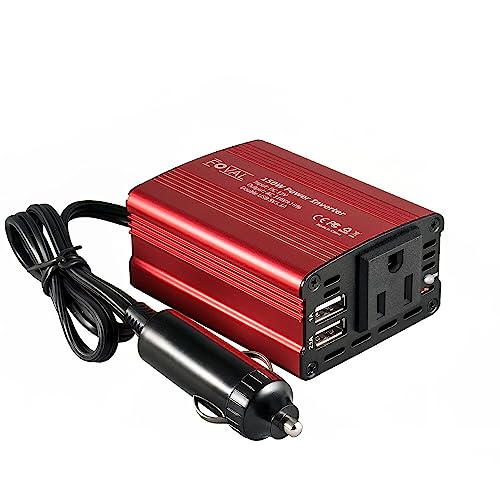
- 150W continuous, 300W peak output
- One AC outlet and dual USB ports
- Compact aluminum housing with safety protections
Best For: Compact charging on road trips and mobile workdays
High-Output Travel Pick
Pro Chaser 400W Vehicle Inverter

- 400W continuous, 800W peak output
- Dual AC sockets plus dual USB ports
- Protection circuitry and temperature-controlled fan
Best For: Multi-device travel charging and moderate-power electronics
Best Compact Pick
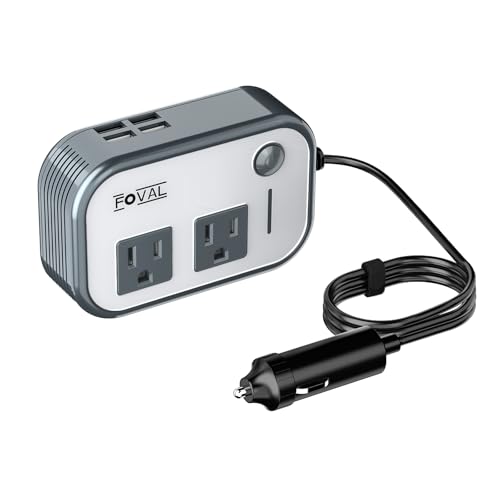
- Two AC outlets plus four USB ports
- Compact and lightweight for travel
- 24-month warranty and multiple protections
Best For: Everyday charging of smaller electronics in a 12V vehicle
Best High-Power Option
OLTEANP 1000W Car Power Inverter

- 1000W continuous and 2000W peak output
- LCD monitoring with protection indicators
- Includes battery clips and multiple charging ports
Best For: Camping, trucks, and higher-power compatible devices
Best Fast-Charging Pick
BESTEK 400W Car Power Inverter

- 400W output with two AC outlets
- 30W USB-C PD and USB-A QC 3.0
- Compact, ETL-certified design
Best For: Travelers needing fast charging and moderate AC power
Best Compact Car Inverter – BESTEK 300W Car Plug Adapter
For everyday car inverters use, the BESTEK 300W model is a compact option for charging laptops, tablets, phones, cameras, and other compatible devices from a vehicle outlet. It offers two AC outlets, dual USB charging, and a 32-inch lighter plug cable for flexible placement.
Best For: Road trips, work travel, camping, and light-duty device charging in compatible 11–17V vehicles.
Pros:
- 300W continuous output with 700W peak capacity.
- Two AC outlets and two 4.8A USB ports.
- Compact aluminum housing, built-in fuse, and multiple safety protections.
- Includes a five-year replacement warranty according to the supplied notes.
Cons:
- Modified sine wave output may not suit every sensitive or motor-driven appliance.
- Its 300W continuous rating is intended for smaller electronics, not high-demand equipment.
This is a practical choice when portability and convenient charging matter more than high wattage. Confirm your vehicle voltage and device requirements before use.
Best High-Power Pure Sine Car Inverter – BELTTT 2000W 12V Inverter
The BELTTT 2000W model is one of the more capable car inverters for RVs, trucks, off-grid setups, and battery-powered applications. Its pure sine wave output, LCD monitoring, hardwire connection, and 4,000W surge rating make it suited to larger or more sensitive loads than a plug-in travel inverter.
Best For: RVs, trucks, outdoor use, and off-grid battery systems needing high continuous output and pure sine wave power.
Pros:
- 2,000W continuous output with 4,000W peak surge capacity.
- Pure sine wave output is designed for sensitive and inductive loads.
- LCD displays input/output voltage, battery status, and load conditions.
- Includes dual AC sockets, a 20A outlet, USB port, hardwire port, remote, cables, and fuses.
Cons:
- At 7.7 pounds and nearly 15 inches long, it is less portable than compact car-plug models.
- Requires a suitable 12V battery installation rather than simple cigarette-lighter use.
- The supplied notes list a one-year warranty.
Choose this inverter when reliable, cleaner AC power and substantial capacity are priorities. Proper battery cabling and installation are essential for its high-power output.
Best Versatile Travel Car Inverter – POWERFUEL 1200W Multi-Port Inverter
The POWERFUEL 1200W is a versatile choice among car inverters for road trips, camping, commuting, and emergency use. It combines three AC outlets with USB and Type-C charging, while its LCD screen shows operating information and its temperature-controlled fan is designed for quieter operation.
Best For: Travelers and vehicle owners who need several charging ports for phones, tablets, laptops, lights, routers, or fans.
Pros:
- Three AC outlets, three USB ports, and one Type-C port.
- 1200W peak output supports multiple connected devices within its limits.
- LCD monitor displays input voltage, output voltage, and battery level.
- Six-way protection includes overvoltage, undervoltage, overload, overheating, short circuit, and reverse polarity protection.
Cons:
- The supplied notes specify peak output but do not provide a continuous wattage rating.
- Its 12V direct-current input requires attention to battery and vehicle compatibility.
This model emphasizes connectivity and visibility rather than specialized high-power installation. It is a sensible travel-oriented option, provided the connected load stays within the inverter’s actual operating limits.
Best RV-Ready Car Inverter – LANDERPOW 3000W Pure Sine Inverter
The LANDERPOW 3000W model is built for demanding 12V battery applications, making it a strong candidate for RVs, job sites, solar systems, and emergency power. Among car inverters, its pure sine wave output, 6,000W peak rating, hardwired terminal, heavy-gauge cables, and remote monitoring favor permanent or semi-permanent installations.
Best For: RV owners, work vehicles, off-grid systems, and users powering high-startup or sensitive equipment from a 12V battery.
Pros:
- 3,000W continuous output with 6,000W surge capacity.
- Pure sine wave power is intended for electronics, appliances, tools, and inductive loads.
- Three AC outlets, hardwired terminal, USB charging, and 30W PD port.
- Includes 1 AWG copper cables, a 15-foot wired remote, safety protections, and a three-year coverage plan.
Cons:
- High output requires suitable battery capacity, wiring, fusing, and installation.
- Its size and installation-oriented design are less convenient for casual plug-in use.
- The supplied details are truncated, so some specifications are not available.
This is the most installation-focused option in the group and offers substantial capacity for RV and emergency applications. Its capabilities are best matched with a properly configured 12V battery system rather than a standard vehicle accessory socket.
Quiet Compact Pick – DEWALT DXAEPI140 140W Vehicle Inverter
For drivers who want compact car inverters for everyday charging, the DEWALT DXAEPI140 delivers 140 watts of continuous household power through a vehicle’s 12V outlet. Its silent, fan-free design and dedicated USB-C and USB-A ports make it suited to quiet in-car use.
Best For: Quiet charging of phones, tablets, and other modest-power devices during commutes, road trips, or work-site travel.
Pros:
- Provides 140 watts of continuous power with a 280-watt peak output.
- Includes 25W USB Type-C and 15W USB Type-A charging ports.
- Fan-free operation runs quietly, while low-voltage regulation helps prevent battery drain.
- Includes an installation kit for permanent vehicle mounting.
Cons:
- Its 140-watt capacity is intended for lower-power electronics rather than demanding appliances.
- The modified sine-wave output may not suit every sensitive device.
The DXAEPI140 is a practical choice when quiet operation, USB charging, and straightforward vehicle installation matter more than high wattage. Its automatic shutoff adds useful protection for the vehicle battery.
Portable Road-Trip Value – FOVAL 150W Car Power Inverter
The FOVAL 150W is one of the more portable car inverters for adding an AC outlet and dual USB charging to a vehicle. Its credit-card-sized aluminum housing is easy to store, while the 3.1A combined USB output supports simultaneous phone and tablet charging.
Best For: Road trips, work travel, and mobile living situations where compact size and flexible device charging are priorities.
Pros:
- Offers 150 watts of continuous power and 300 watts of peak output.
- Combines one AC outlet with two USB ports in a compact design.
- Built-in protections address overheating, voltage issues, short circuits, overloads, and overcharging.
- Includes a quiet cooling fan and a two-year manufacturer warranty.
Cons:
- The single AC outlet limits how many AC devices can be connected at once.
- Its modified sine-wave output may not be ideal for every sensitive electronic device.
With its lightweight metal housing and broad protection features, the FOVAL is a convenient lower-power inverter for travelers. It is best matched with electronics and small devices within its 150-watt continuous rating.
High-Output Travel Pick – Pro Chaser 400W Vehicle Inverter
The Pro Chaser 400W gives drivers more capacity than many compact car inverters, with 400 watts of continuous output and an 800-watt peak. Two AC sockets and dual 3.1A USB ports provide room for several devices, while the 30-inch cord makes placement more flexible.
Best For: Road trips, family travel, and outdoor use requiring multiple charging connections or moderate-power devices such as laptops and small travel electronics.
Pros:
- Delivers 400 watts continuously with an 800-watt peak output.
- Provides two 110V AC sockets and dual USB ports.
- Includes overload, voltage, and overheating protection.
- Temperature-controlled cooling fan activates at 113°F, and a 12-month warranty is included.
Cons:
- The modified sine-wave output may not work equally well with all sensitive equipment.
- It should be used only in a cool, dry environment as directed by the manufacturer.
- Its higher output can place greater demands on a vehicle’s 12V system.
The Pro Chaser stands out when you need more outlets and substantially more capacity in a compact vehicle inverter. Check each device’s power requirements and use the inverter in the recommended environment for dependable operation.
Best Compact Pick – FOVAL 200W Car Power Inverter
For everyday car inverters use, the FOVAL 200W model is a compact option for charging several smaller devices at once. It provides two AC outlets and four USB ports, while built-in protections and a temperature-controlled fan support convenient travel use.
Best For: Road trips, commuting, and charging phones, tablets, laptops, and other lower-power electronics from a 12V vehicle socket.
Pros:
- Offers two AC outlets and four USB charging ports.
- Compact, lightweight design is easy to store and carry.
- Includes short-circuit, low-voltage, overcharge, overload, and over-temperature protection.
- Backed by a 24-month warranty.
Cons:
- Designed for 12V vehicles and not for 24V systems or airplane use.
- Not suitable for high-power appliances such as hair dryers or electric heaters.
- Uses a modified sine wave output.
The FOVAL is a sensible choice when portability and plenty of charging ports matter more than high wattage. Its 200W capacity is best reserved for electronics and other modest loads.
Best High-Power Option – OLTEANP 1000W Car Power Inverter
Among these car inverters, the OLTEANP 1000W model is the choice for substantially higher power needs. It includes battery clips for larger loads, two AC outlets, USB charging, and an LCD that displays voltage, battery status, and protection alerts.
Best For: Car camping, truck use, van life, outdoor work, and powering compatible electronics or appliances under 1000W.
Pros:
- Provides 1000W continuous output and 2000W peak surge power.
- Includes battery clips for loads beyond the cigarette-lighter socket’s stated 150W limit.
- LCD shows input voltage, output voltage, battery status, and fault codes.
- Offers two AC outlets, 36W USB-C, and 5V/3A USB output.
Cons:
- The cigarette-lighter connection supports up to 150W; higher loads require direct battery connection.
- Modified sine wave output is not recommended for refrigerators, microwaves, air conditioners, laser printers, or sensitive medical devices.
- At about 1.2 kg, it is less lightweight than compact car-socket models.
This inverter delivers the broadest power range here, but safe setup is important. Use the included clips for higher-power loads and confirm that the device is compatible with modified sine wave output.
Best Fast-Charging Pick – BESTEK 400W Car Power Inverter
The BESTEK 400W is a practical middle ground among car inverters, combining dual AC outlets with fast USB charging in a compact car-plug design. Its USB-C PD and USB-A QC 3.0 ports make it especially useful when several personal devices need power during travel.
Best For: Road trips, camping, and charging phones, tablets, cameras, laptops, breast pumps, and other compatible devices up to its stated output.
Pros:
- Supplies 400W output through two 110V AC outlets.
- Includes 30W USB-C PD and USB-A QC 3.0 fast-charging ports.
- Compact design is approximately the size of an iPhone.
- ETL-certified and equipped with a 40-amp fuse plus multiple charging protections.
Cons:
- Limited to 12V vehicle systems.
- Its 400W output is below the capacity of high-power battery-connected inverters.
- Includes a 12-month replacement warranty rather than the longer coverage offered by some models.
Choose the BESTEK when fast personal-device charging and portability are priorities. It offers more AC capacity than a basic compact inverter without moving into the bulk and setup requirements of a 1000W model.
How We Picked These Car Inverters
We selected models across several common use cases, from compact inverters designed for phones and laptops to high-output units intended for direct battery connections and RV equipment. We compared continuous wattage, peak or surge capacity, outlet and USB options, input-voltage compatibility, portability, and the practical limits of vehicle power systems.
Safety and usability also matter. Useful protections include overload, short-circuit, over-temperature, and low-voltage shutdown. A clear display, cooling fan, durable cable, and secure connections can make an inverter easier and safer to use, especially during long trips or outages.
Quick Comparison
| Use case | Recommended class | What to look for |
|---|---|---|
| Phones, tablets, cameras | 150–200W plug-in | USB-A and USB-C ports, compact size |
| Laptops and small electronics | 300–400W plug-in | AC outlet, stable cooling, overload protection |
| Several devices or light tools | 800–1,200W | Direct battery wiring, heavier cables, cooling |
| RV equipment and demanding loads | 2,000–3,000W pure sine wave | Battery-bank compatibility and professional installation |
Key Buying Factors for Car Inverters
Continuous and Surge Wattage
Continuous wattage is the amount an inverter can supply during normal operation. Surge wattage handles the brief startup demand of motors, compressors, and some power tools. Check the appliance label and choose an inverter with comfortable headroom rather than matching the numbers exactly.
Plug-In Versus Direct Battery Connection
Small inverters can usually connect to a 12-volt accessory socket, but that socket and its fuse limit available power. High-output models generally require short, thick cables connected directly to the battery. Never assume a 2,000W or 3,000W inverter can safely run through a dashboard outlet.
Waveform, Ports, and Protection
Pure sine wave output is the safest choice for sensitive electronics, medical equipment, audio systems, and appliances with motors. Modified-sine models can be suitable for basic chargers and simple loads. Also consider the number of AC outlets, USB-C charging support, fan noise, display readability, and built-in protection systems.
Who Should Buy Which Car Inverters?
Choose a compact 150W–200W model for phones, tablets, cameras, and occasional laptop charging. A 300W–400W inverter is a better fit for road-trip workstations, multiple chargers, and small electronics. If you need to power several devices or light-duty equipment, consider a 1,000W–1,200W model—but plan for direct battery wiring and adequate ventilation.
For RV use, emergency backup, or appliances with high startup demands, a 2,000W–3,000W pure sine wave inverter offers more capability, provided the battery bank, cables, fuses, and installation are properly sized. In every case, stay within the vehicle manufacturer’s electrical limits, keep ventilation openings clear, and avoid running an inverter unattended in an enclosed vehicle.