Removing or installing an automatic transmission is far easier when the load is supported by equipment designed for controlled lifting, positioning, and lowering. The best transmission jacks for automatic transmissions combine a stable base, useful height range, adjustable saddles, and dependable restraints.
This roundup compares 10 options across professional shop jacks, low-profile models, and floor-jack adapters so you can match capacity and design to your vehicle, workspace, and repair routine.
Best 10 Transmission Jacks for Automatic Transmissions Picks for 2026
Best Heavy-Duty Telescopic Pick

- 1,000-lb hydraulic capacity
- Foot-operated pump and tilt saddle
- 35–74-in. lifting range with tie-down
Best For: Heavy transmission work in home garages and professional shops
Best Low-Profile Option
Garvee 450-LB Transmission Jack

- 7–23-in. adjustable lift range
- Swivel casters and locking wheels
- 450-lb capacity with nylon strap
Best For: Low-clearance undercar repairs and lighter transmissions
Best Floor-Jack Upgrade
Performance Tool W41044 Adapter
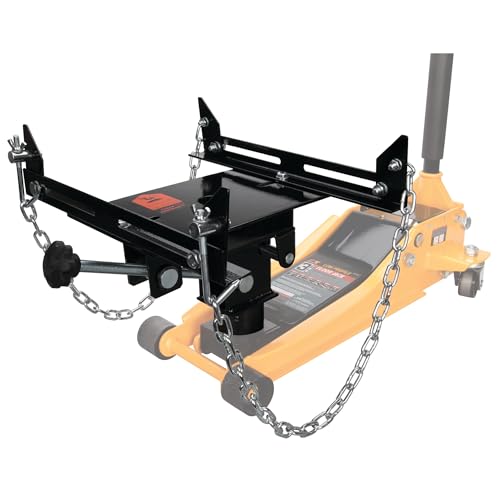
- Converts a compatible floor jack
- 300-lb capacity for lighter applications
- Adjustable tilt and safety chains
Best For: Users adapting an existing heavy-frame floor jack
Best Air-Assisted Model
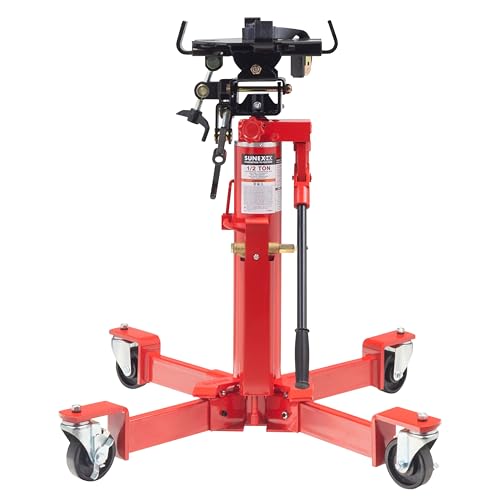
- 1,000-lb capacity with 35–73.5-in. lift
- Four adjustable saddle arms
- 37° forward and 26° backward tilt
Best For: Professional shops with regulated compressed air
Best Budget-Friendly Pick
MAXSA 450 lb Transmission Jack

- 450-pound Q235 steel capacity
- 7- to 23-inch adjustable lift
- Swivel casters, locks, and safety strap
Best For: DIY garages handling lighter transmissions and undercarriage work
Best High-Capacity Telescoping Pick
VEVOR 1100 lb Transmission Jack

- 1,100-pound hydraulic capacity
- 33.5- to 67-inch telescoping lift
- Foot pedal and 30-degree tilting saddle
Best For: Shops needing tall, high-capacity support for cars and light trucks
Best Low-Profile Heavy-Duty Pick
1100 lb Low-Profile Transmission Jack

- 1,100-pound alloy-steel capacity
- 7.68- to 24.8-inch lift range
- Adjustable tilt saddle and swivel casters
Best For: Low-clearance vehicle work and heavy transmission service
Fast-Lift Workshop Power
Dual Plunger Hydraulic Transmission Jack
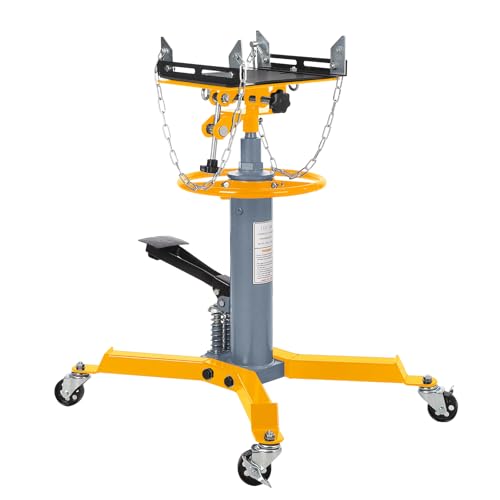
- 1322 lb capacity and 33.5–69 in. lift range
- Dual plungers and foot pedal support fast, controlled lifting
- Safety chains, non-slip pad, brakes, and tilting tray included
Best For: Professional shops and lift-supported transmission service
Low-Clearance Garage Pick
Garvee 450 lb Transmission Jack

- 7–23 in. lift range suits low-clearance vehicles
- Two-meter safety straps help prevent load shifting
- Four brake wheels support movement and secure positioning
Best For: Home garages and general car or small-truck repair
Low-Profile Heavy-Duty Control
VEVOR Adjustable Floor Transmission Jack

- 1000 lb lifting capacity with a 6.3–25.2 in. range
- 360-degree adjustable tray tilts up to 30 degrees
- Pump handle and return valve support controlled movement
Best For: Low-clearance, heavy-duty floor-level drivetrain work
Best Heavy-Duty Telescopic Pick – Sunex 7793B
For shoppers comparing transmission jacks for automatic transmissions, the Sunex 7793B is a full-size hydraulic option with a 1,000-pound capacity and a tall 35- to 74-inch lifting range. Its foot-operated pump, tilt saddle, and tie-down strap are designed for controlled positioning during transmission service.
Best For: Home garages and professional shops handling heavier car transmission removal and installation.
Pros:
- 1,000-pound rated capacity supports substantial transmission loads.
- Foot pump allows hands-free raising of the hydraulic rams.
- Tilt saddle and nylon strap help with alignment and load security.
- Telescopic design reaches approximately 74 inches and lowers for transfer to a work table.
Cons:
- At 163.4 pounds, it is substantially heavier than compact alternatives.
- Its 35-inch minimum height may not suit every low-clearance application.
The 7793B emphasizes capacity, reach, and controlled handling rather than portability. The overload valve and universal car fit add practical shop-oriented features, while the one-year warranty provides basic coverage.
Best Low-Profile Option – Garvee 450-LB Transmission Jack
The Garvee 450-LB is a low-profile choice among transmission jacks for automatic transmissions, with a 7- to 23-inch adjustable lift range. Its steel frame, swivel casters, locking wheels, and nylon safety strap focus on maneuverability and secure positioning for undercar work.
Best For: Compact sedans, pickups, light-duty trucks, and garages needing a more compact transmission-lifting platform.
Pros:
- Low 7-inch minimum height helps with under-vehicle access.
- Four swivel casters support positioning, while two locking wheels help secure the jack.
- Widened base and nylon strap provide added support and load retention.
- 450-pound capacity and multipurpose design also suit exhaust and other undercar repairs.
Cons:
- Its 450-pound capacity is lower than the 1,000-pound models in this roundup.
- The 23-inch maximum height is limited for some taller service applications.
- The listed manufacturer warranty is only 30 days.
The Garvee is suited to users who value low access height and easy shop movement over maximum lifting capacity. Confirm the transmission weight and required working height before choosing it for a particular vehicle.
Best Floor-Jack Upgrade – Performance Tool W41044 Adapter
If you already own a compatible floor jack, the Performance Tool W41044 offers a space-saving way to create transmission jacks for automatic transmissions without buying a dedicated lifting unit. The steel adapter adds 11 inches of height, provides adjustable forward-and-back tilt, and includes safety chains.
Best For: Passenger-car and light-duty-truck owners who want to adapt an existing heavy-frame floor jack.
Pros:
- Converts a compatible floor jack into a transmission jack.
- 300-pound capacity is intended for passenger cars and light-duty trucks.
- Adjustable tilt helps with removal and installation alignment.
- Two safety chains and a cradle-style platform help secure the load.
Cons:
- It requires a compatible saddle post hole, including the specified 1-5/32-inch size.
- Its 300-pound capacity is lower than dedicated 1,000-pound transmission jacks.
- It depends on the condition and capacity of the floor jack used with it.
The W41044 is a practical adapter rather than a standalone jack. Check your floor-jack saddle dimensions and the transmission weight carefully before purchase, since compatibility is central to safe use.
Best Air-Assisted Model – Sunex 7796 Air/Hydraulic Jack
The Sunex 7796 combines air and hydraulic operation for demanding transmission service. As one of the more fully adjustable transmission jacks for automatic transmissions, it offers a 1,000-pound capacity, four ratcheting saddle arms, broad tilt adjustment, and a 35- to 73.5-inch lift range.
Best For: Shops with regulated compressed air that need precise transmission positioning and frequent service capability.
Pros:
- Air-assisted first-stage lifting and hydraulic second-stage operation support flexible use.
- Four adjustable saddle arms fit transmission oil-pan mounting flanges.
- Saddle tilts forward, backward, and side to side for alignment.
- 1,000-pound capacity, locking casters, and a tie-down strap support shop use.
Cons:
- The air stage requires shop air regulated to 100 psig.
- Its 35-inch minimum height may be too high for some vehicles.
- At 160 pounds, it is not a lightweight or highly portable option.
The 7796 stands out when adjustment range and repeatable shop operation matter. Its air requirement makes it less convenient for basic home garages, but the saddle articulation and 1,000-pound rating suit professional transmission work.
Best Budget-Friendly Pick – MAXSA 450 lb Transmission Jack
For shoppers seeking transmission jacks for automatic transmissions, the MAXSA offers a practical, lower-capacity option for routine garage work. Its adjustable 7- to 23-inch lift range and safety strap support transmission removal, installation, and other undercarriage tasks.
Best For: Home garages and DIY mechanics working with lighter transmissions and general undercarriage repairs.
Pros:
- Q235 steel frame supports up to 450 pounds.
- 7- to 23-inch adjustable lift range suits cars and full-size trucks.
- 360-degree swivel casters and lockable wheels help with positioning.
- Nylon safety strap helps secure the supported transmission.
Cons:
- 450-pound capacity is lower than the other listed options.
- Its 46.3-pound weight and compact dimensions may limit stability for very heavy drivetrain components.
This is a straightforward choice when portability, a low starting height, and basic transmission support matter more than maximum capacity. The 30-day manufacturer warranty is relatively limited.
Best High-Capacity Telescoping Pick – VEVOR 1100 lb Transmission Jack
Among transmission jacks for automatic transmissions, the VEVOR stands out for its 1,100-pound capacity and unusually tall 33.5- to 67-inch telescoping range. Its foot pedal, tilting saddle, and safety chains are designed for controlled positioning during automotive and light-truck service.
Best For: Shops and mechanics needing high capacity and substantial lifting height for cars or light trucks.
Pros:
- 1,100-pound, half-ton load capacity handles heavier transmissions.
- 33.5- to 67-inch two-stage hydraulic lift provides extensive height adjustment.
- Foot-operated pedal leaves both hands available for positioning.
- 30-degree adjustable saddle tilt and two safety anchor chains support alignment and load security.
Cons:
- At 96 pounds, it is considerably heavier than a compact floor jack.
- The 33.5-inch minimum height is not intended for low-clearance under-vehicle access.
- Its larger footprint may require more garage or shop space.
This model makes the most sense when lifting height and load capacity are priorities. Its tall design is useful for elevated service work, but buyers should confirm that their vehicle setup accommodates the 33.5-inch starting height.
Best Low-Profile Heavy-Duty Pick – 1100 lb Low-Profile Transmission Jack
This low-profile option is a strong fit for transmission jacks for automatic transmissions when under-vehicle access is the main concern. It combines a 1,100-pound alloy-steel structure with a 7.68- to 24.8-inch lift range and an adjustable tilt saddle for transmission alignment.
Best For: DIY mechanics and repair shops working beneath passenger cars, SUVs, light trucks, and other vehicles with limited clearance.
Pros:
- 1,100-pound capacity supports transmission and drivetrain service.
- 7.68-inch minimum height helps it fit beneath lower vehicles.
- Adjustable saddle tilt assists with removal, installation, and alignment.
- Four 360-degree swivel casters simplify positioning in confined garage spaces.
Cons:
- Its 99.1-pound weight makes it less convenient to move than lighter jacks.
- 24.8-inch maximum height is substantially lower than a telescoping shop jack.
- The supplied notes do not specify locking casters or a safety strap.
Choose this model for a combination of low access height and heavy-duty capacity. It is especially practical for floor-level transmission work, though its limited maximum height may not suit elevated service setups.
Fast-Lift Workshop Power – Dual Plunger Hydraulic Transmission Jack
For shops comparing transmission jacks for automatic transmissions, this dual-plunger model emphasizes fast lifting, substantial capacity, and controlled positioning. Its two-stage telescoping design reaches 33.5 to 69 inches, while the foot pedal, tilting tray, safety chains, and non-slip pad support transmission removal and installation on vehicles supported by lifts.
Best For: Professional shops and enthusiasts needing a tall, high-capacity jack for cars and light trucks.
Pros:
- 1322-pound load capacity with a wide carbon-steel base.
- Dual plungers reach maximum height in about 20 seconds, according to the supplied product details.
- Foot-operated control supports gradual descent, while the tray tilts up to 30 degrees.
- Four swivel casters, two brakes, safety chains, and an 8 mm non-slip pad add usability and load security.
Cons:
- Its 97-pound weight and 33.5-inch minimum height make it less suited to low-clearance work.
- The tall, heavy-duty design may be more jack than needed for basic home-garage repairs.
Choose this model when lifting height, capacity, and precise foot-pedal control matter more than portability or low-profile access. It is particularly appropriate for transmission work performed with a vehicle lift.
Low-Clearance Garage Pick – Garvee 450 lb Transmission Jack
Among transmission jacks for automatic transmissions, the Garvee stands out for its compact low-profile format. The 7 to 23-inch lift range is designed to fit beneath lower vehicles, and its 450-pound capacity, safety straps, and locking wheels make it suited to general car and truck repair in a home garage or workshop.
Best For: Home mechanics and general repair users who need low-clearance access and easy movement.
Pros:
- Low 7-inch minimum height helps it fit beneath compact cars and small trucks.
- Two-meter safety straps help secure transmissions during lifting and lowering.
- Four universal brake wheels provide 360-degree movement with locking stability.
- Simple operation is intended for fast lifting and precise control.
Cons:
- The 450-pound capacity is substantially lower than heavier-duty transmission jacks.
- The 23-inch maximum lift may not provide enough height for every vehicle or service setup.
This is a practical choice when low entry height and maneuverability are priorities. Verify the transmission weight and required service height before choosing it for larger or more demanding applications.
Low-Profile Heavy-Duty Control – VEVOR Adjustable Floor Transmission Jack
For buyers seeking transmission jacks for automatic transmissions that can enter tight spaces, this VEVOR floor jack combines a 6.3 to 25.2-inch lift range with a 1000-pound lifting capacity. Its adjustable, 360-degree rotating tray can tilt up to 30 degrees, while the pump handle and return valve support controlled positioning during installation.
Best For: Heavy-duty floor-level transmission, driveshaft, and axle work where low access is important.
Pros:
- Supports up to 1000 pounds for lifting transmissions, driveshafts, and axles.
- 6.3-inch minimum height provides strong low-profile access.
- Tray rotates 360 degrees, adjusts in width, and tilts up to 30 degrees for alignment.
- Two swivel casters and two fixed wheels provide mobility, while the return valve enables a slow descent.
Cons:
- Its 82-pound weight is less convenient to transport than compact models.
- Chains must be used to secure parts, and the vehicle must be supported with jack stands before use.
- The 25.2-inch maximum height may not suit work requiring a taller transmission jack.
Pick the VEVOR when low-profile entry, tray adjustability, and higher capacity are more important than a lightweight design. Its floor-jack layout is especially useful for controlled alignment in confined work areas.
How We Picked the Best Transmission Jacks for Automatic Transmissions
We compared these models by rated capacity, minimum and maximum lift height, saddle adjustability, chassis stability, wheel design, restraint features, and operating method. We also considered whether each jack is intended for frequent shop use or occasional garage repairs. A high weight rating matters, but it does not replace correct load positioning, a stable floor, and secure transmission attachment.
Specifications can vary by seller and configuration, so confirm the current capacity, dimensions, included straps or chains, and saddle compatibility before ordering.
Quick Comparison
| Type | Best suited to | What to prioritize |
|---|---|---|
| Telescoping hydraulic jack | Professional or frequent service | Capacity, reach, saddle adjustment, stability |
| Low-profile transmission jack | Cars and lower vehicles | Minimum height, wheel clearance, tilt range |
| Floor-jack adapter | Occasional garage work | Saddle-shaft fit, retention, compatible floor jack |
| Air and hydraulic jack | Busy repair environments | Air supply requirements and lifting control |
Key Buying Factors for Transmission Jacks for Automatic Transmissions
Capacity and Load Balance
Choose a jack with a comfortable margin above the transmission’s actual weight, including fluid, transfer-case components, adapters, or attached hardware. The load should sit centered over the saddle; maximum capacity is not a reason to exceed the manufacturer’s positioning instructions.
Lift Range and Clearance
Measure both the lowest point under the vehicle and the height needed to align the transmission with the bellhousing. Low-profile designs help under cars and lowered vehicles, while tall telescoping models provide useful reach for trucks and lifts.
Saddle Adjustment and Restraint
Adjustable tilt saddles and arms make alignment easier and reduce awkward pushing. Chains or safety straps are important because a transmission can shift as its center of gravity changes. Verify that the restraint system is rated and positioned for your transmission.
Mobility and Control
Swivel casters improve positioning, while locking wheels help prevent movement during installation. Foot pumps, dual plungers, and air-over-hydraulic operation affect speed and convenience. Check for smooth lowering control and adequate access around the vehicle.
Who Should Buy Which Transmission Jacks for Automatic Transmissions?
Choose a heavy-duty telescoping or air-and-hydraulic model if you service transmissions regularly, work on trucks, or need substantial height and capacity. A low-profile 450-pound-class jack is a practical choice for many cars and home garages when its height and capacity match the vehicle.
For occasional repairs, a floor-jack adapter can be economical if you already own a compatible floor jack and can verify the saddle-shaft dimensions. Select a higher-capacity low-profile or dual-plunger model when the transmission is heavier, the vehicle has limited clearance, or you want more stability during alignment.
Regardless of model, use jack stands or a lift to support the vehicle, follow the manufacturer’s instructions, secure the transmission before moving it, and never work beneath an inadequately supported vehicle.